


By Ryan “Dickie” Thompson
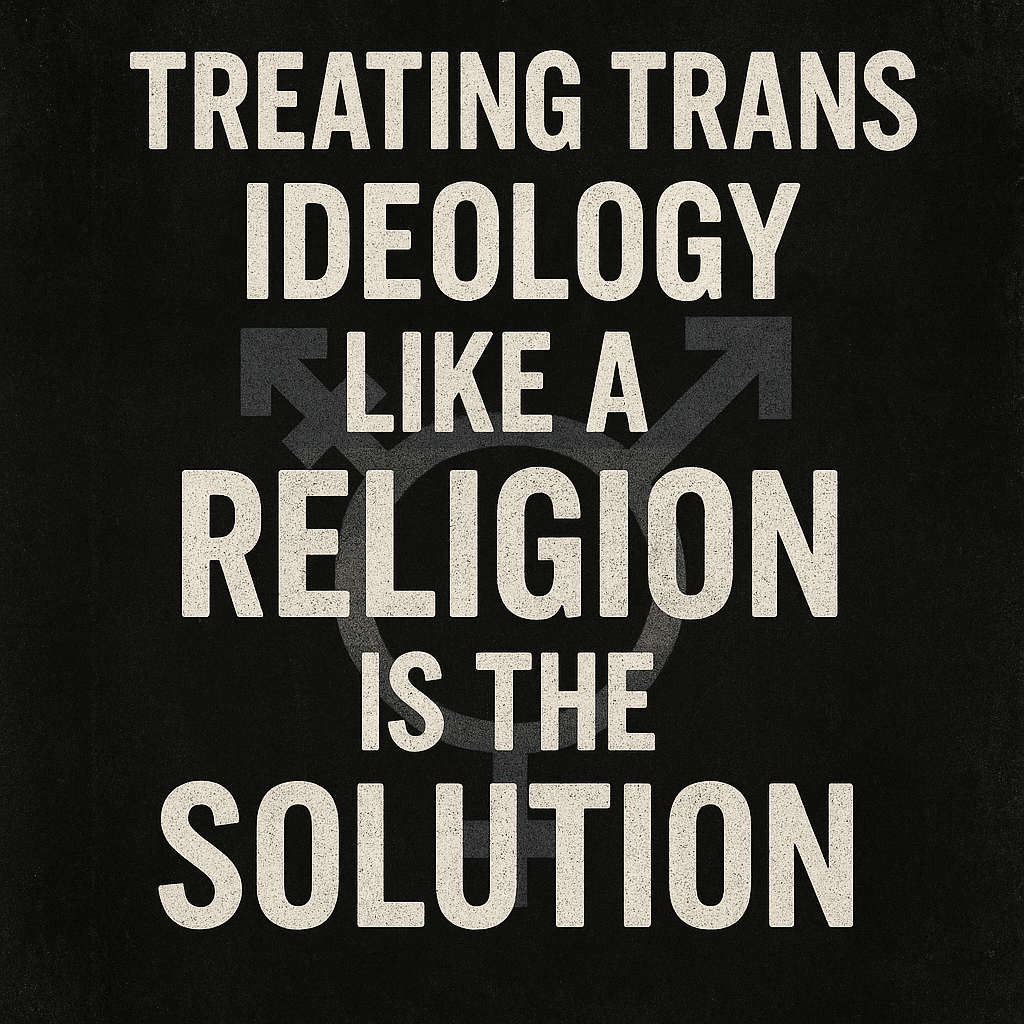
In the culture war over gender identity, one of the most underused and overlooked solutions is the simplest: treat trans ideology the same way we treat religion. That’s not meant as a put-down. It’s actually a framework that could help bring clarity, fairness, and peace to an increasingly divisive issue. If someone sincerely believes they were born in the wrong body, that’s fine. But just like with religion, belief does not obligate others to agree or participate.
Let’s break it down. My response based on the following Vlog by “King Critical”
What is a Religion?
According to Merriam-Webster, religion is:
“A personal set or institutionalized system of religious attitudes, beliefs, and practices.”
- a particular system of faith and worship.plural noun: religions“the world's great religions”
- a pursuit or interest to which someone ascribes supreme importance.”consumerism is the new religion”
This can include belief in things that are unverifiable or faith-based—heaven, karma, reincarnation, or divine intervention. Religious belief isn’t something we demand everyone else affirm. A Catholic doesn’t expect a Muslim to accept the Trinity. A Buddhist doesn’t insist a Christian agree with reincarnation. You’re free to believe as you wish, but you’re not free to force others to participate in your belief system.
This is the logical, fair approach. It respects freedom of conscience while protecting others from being compelled into ideological compliance.
So how does this relate to trans identity?
Trans Identity as a Belief System
When someone says they are a “woman trapped in a man’s body,” what they are really expressing is a deeply held personal belief. This is not a biological fact. Biologically, sex is binary and determined by chromosomes (XX or XY). Gender dysphoria, the discomfort some people feel with their sexed body, is real. But the idea that someone is the opposite sex based on feelings is metaphysical, not material.
That makes it a belief. And not just a private belief, but one that increasingly comes with rituals (pronoun declarations), dogma (“trans women are women”), and even heresy laws (misgendering is hate speech).
This belief system doesn’t require evidence. It requires affirmation. That’s the core of faith.
So if we follow the logic, trans identity is not just a personal statement. It functions like a religion.
Why This Matters
Here’s the thing: If someone believes something sincerely, that belief can still be wrong or not universally applicable. Take religion. A devout Hindu might believe eating beef is sinful. But they don’t have the right to stop you from ordering a cheeseburger.
Likewise, someone can believe they are a woman, but they shouldn’t have the right to compel everyone else to see them as such.
Trans ideology insists that others change their speech, views, and even their policies to comply with a personal identity belief. That’s coercion. And that’s the exact kind of overreach that would never be tolerated if it came from a religious group.
If a Christian demanded the state recognize the Holy Trinity on official documents or forced public schools to teach that Jesus is Lord, people would call it out for what it is: religious imposition.
So why is it any different when the state rewrites legal definitions of sex to accommodate gender identity?
No Trinity Recognition Act, No Gender Recognition Act
As noted in my breakdown of the debate with Papa Gut, if we acknowledge trans identity as a belief system, then the very existence of legal mechanisms like the Gender Recognition Act becomes questionable. Why? Because we don’t legally validate other faith-based claims.
There is no law that says the government must recognize someone's belief in the Trinity, karma, or reincarnation. And rightly so. The state has no business affirming religious or metaphysical claims.
So why does it affirm gender identity, which is, at its core, a metaphysical claim?
The Moral Weight of Labels
Trans ideology turns labels like “man” and “woman” into moral statements rather than biological descriptions. If you misgender someone, it’s treated not as a factual mistake but as a moral sin.
But this only makes sense if we assume there is moral significance to these categories. In reality, “woman” is simply a biological term, not a badge of honor or insult.
To call a man a woman because he feels like one is like calling a person Catholic because they light a candle and say Hail Mary—without believing in Catholic doctrine. It's a superficial performance of identity, not actual membership in the category.
Why This Framework Works
Treating trans identity like a religion has benefits for everyone:
- Freedom of belief: Trans individuals can believe what they want and live according to that belief.
- Freedom from coercion: Others aren’t forced to affirm, adopt, or participate in beliefs they don't share.
- Boundaries for policy: The state doesn’t write laws based on metaphysical beliefs.
- Respect for science: Biological sex remains a stable and factual category.
You can be kind without capitulating. You can be respectful without affirming untruths. Just like you can respect a Muslim without saying “There is no god but Allah,” you can respect a trans-identifying individual without saying “trans women are women.”
A Year in Southeast Asia Changed My Perspective
I’ve spent the last year traveling throughout Southeast Asia. In all that time, I haven’t seen a single Pride flag. Not one trans flag either. No pronoun pins. No obligatory public displays of affirmation. And yet—here’s the kicker—there are still feminine boys, masculine women, gays, cross-dressers, and more.
They exist. They live. They are seen. But they are not demanding to be affirmed. And nobody is forced to play along. Yet I haven’t seen a spike in suicides, assaults, or mental breakdowns. The people living outside gender norms seem just fine.
This raises an important question: If constant affirmation isn’t required there, why is it a moral mandate in the West? Maybe affirmation culture is not the solution we’re told it is. Maybe it’s a symptom of deeper issues, not a cure.
The Parental Standard: Belief Without Force
As a father, I’ve spent years raising my kids in a home where I live by strong Christian convictions. I’ve shared my testimony at Baptist conventions. My belief in Jesus isn’t lukewarm—it’s central to who I am.
But I’ve never forced my children to adopt my faith. I don’t require them to pray, quote scripture, or attend church. That’s because I believe in conscience, not coercion.
So it doesn’t sit right when someone expects me to adopt their belief system. I don’t ask my kids to recite creeds. Why should they ask me to affirm a metaphysical claim I don’t believe?
Requiring me to use someone’s self-declared pronouns is like requiring someone to say grace before meals or confess a Bible verse in conversation. It’s religious behavior cloaked in the language of identity.
Let people believe what they want. But don’t force others to speak your creed.
Conclusion: Believe What You Want, But Don’t Make It Law
If people want to believe they are a different gender than their biology, they are free to do so. That’s part of a free society. But freedom of belief is not freedom to force others to join in.
Treating trans ideology like a religion is a way to defuse the conflict without denying anyone’s rights. Believe what you want. Live how you want. But don’t force others to pretend your belief is fact.
In a pluralistic society, the best way to maintain peace is to keep belief voluntary and private. That includes religion. And that includes gender ideology.ntity politics, trans activism, gender law


Spun Web Technology SMART SEO