


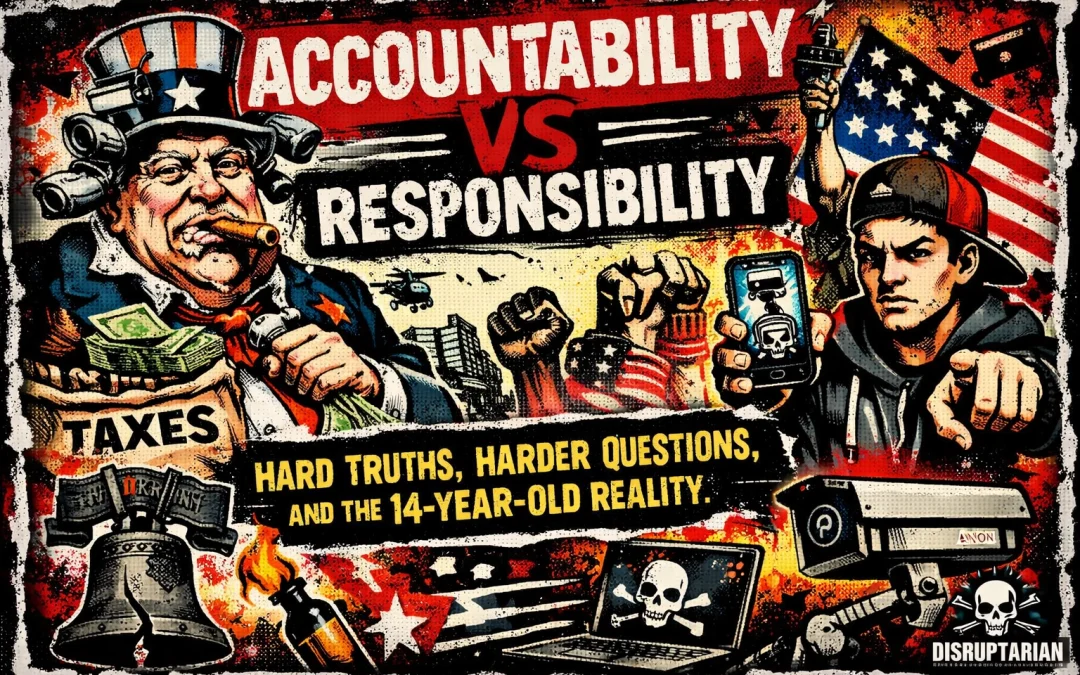
Before we dive into the deep end of the pool, we need to clear the air. People toss the words “responsibility” and “accountability” around like they’re interchangeable. They aren’t. In the world of Disruptarian Radio, where we value individual agency over bureaucratic sludge, getting these definitions right is the difference between being a free agent and being a cog in someone else's machine.
Responsibility means you are connected to the outcome of something. It’s the duty. It’s the task. It’s being the one “in charge” of the gear.
Accountability is much heavier. It means you accept total ownership of what happens next. It’s the internal commitment to answer for the results, good, bad, or ugly. Responsibility can be delegated; accountability cannot. You can give someone the responsibility to fix a leak, but if the house floods, the accountability still sits on your shoulders.
Older generations lived much closer to the intersection of both. If you didn’t plant, you didn’t eat. If you broke something, you fixed it. There was no middleman to absorb the blow. Today? You could argue that most modern systems, government programs, massive institutions, safety nets, and corporate bureaucracies, are designed specifically to separate people from the consequences of their actions.
Sometimes those nets catch people who truly need them. But more often, they strip away the expectation that a human being must personally deal with the results of their life choices. That disconnect is where the rot starts, and it matters most when we stop talking about abstract “systems” and start talking about the hardest issues we face: teen pregnancy, abortion, and moral agency.
The Question My Son Asked
The catalyst for this whole thought process wasn't some high-level policy debate. it was a conversation at home. My son asked a question built around a hypothetical, a brutal, gut-wrenching one.
He asked: If I had been born female, and I was fourteen, and I was raped… would abortion be justified?
And then he followed it up with the real kicker: Even if it was justified, would that still be participating in a form of eugenic thinking, where society decides that because a life started in trauma or under “wrong” conditions, it simply shouldn't exist?
I didn’t pretend I had an easy, pre-packaged answer. Because I don’t. These are the moments where generational thinking hits a wall. Some people have an answer ready before you even finish the sentence. Others wrestle with the moral weight until it leaves a mark. My response wasn't a lecture or a sermon; it was a perspective grounded in the reality of human agency.
“The question to me from my son was
“”So you think that if I was a girl at birth, at my current age, and a man raped me, getting an abortion because I shouldn't have to deal with a pregnancy at 14, it would be me partaking in the ideologies of eugenics?”
My Actual Reply to My Son
I told him my thoughts honestly.
And I want to keep this exactly how I said it.
Because sometimes raw honesty communicates better than polished writing.
Here was my reply:
Our neighbors in Puerto Rico, in fact our landlords started their family and had their first child at age 14
This man in that video from the Philippines was age 12
It's pretty common in recent generations
Mom's mother, grandma Donna got pregnant at age 15
🤷
Is it right?
Is it wrong?
I dunno
But I had my first legal job at age 14 it's on record because I paid social security taxes for it
And I had my first apartment by age 15
I wouldn't have started a family back then personally
I actually waited intentionally until I was 27 for that
But I am just saying, it's not uncommon
Sometimes the best answer you can give a kid is honesty.
Not a sermon.
Just reality.

Image: father and teenage son having serious conversation at kitchen table | ALT: accountability vs responsibility conversation between generations
Adoption vs Abortion: A Path for Life
I told him something simple, though I know it’s not easy. I believe adoption is a better option whenever it is physically and mentally possible.
This isn't because I think pregnancy is a walk in the park or that trauma is trivial. Far from it. It’s because adoption creates a path where life continues, and the massive weight of responsibility shifts to someone who is actually prepared and waiting to raise a child.
According to the U.S. Department of Health and Human Services, hundreds of thousands of children are adopted every year, and there are countless families actively waiting to adopt infants (https://www.acf.hhs.gov/cb). There is a massive demand for life. When we talk about “solutions,” we have to acknowledge that there are alternatives that don’t involve termination.
But I also told him that acknowledging that option doesn't magically erase the complexity of rape or the horror of trauma. Hard questions don’t come with easy answers, and anyone telling you otherwise is likely trying to sell you a political platform. We’re talking about the Gospel of Disruption here, challenging the status quo means looking at the raw, uncomfortable truth.
Is It Physically Possible? The 14-Year-Old Reality
I asked my son a rhetorical question: Is it physically possible to have a child at age fourteen?
Biologically, the answer is a resounding yes. According to the CDC, teenage pregnancy has been a constant throughout human history (https://www.cdc.gov/teenpregnancy). Now, does that make it ideal? No. Does it mean it fits into our modern, Western timeline of “success”? Usually not.
But it makes it real.
Modern conversations often assume that a 14-year-old parent is some kind of unprecedented medical anomaly or a sign of total societal collapse. But history, and the rest of the world, has a very different story to tell.
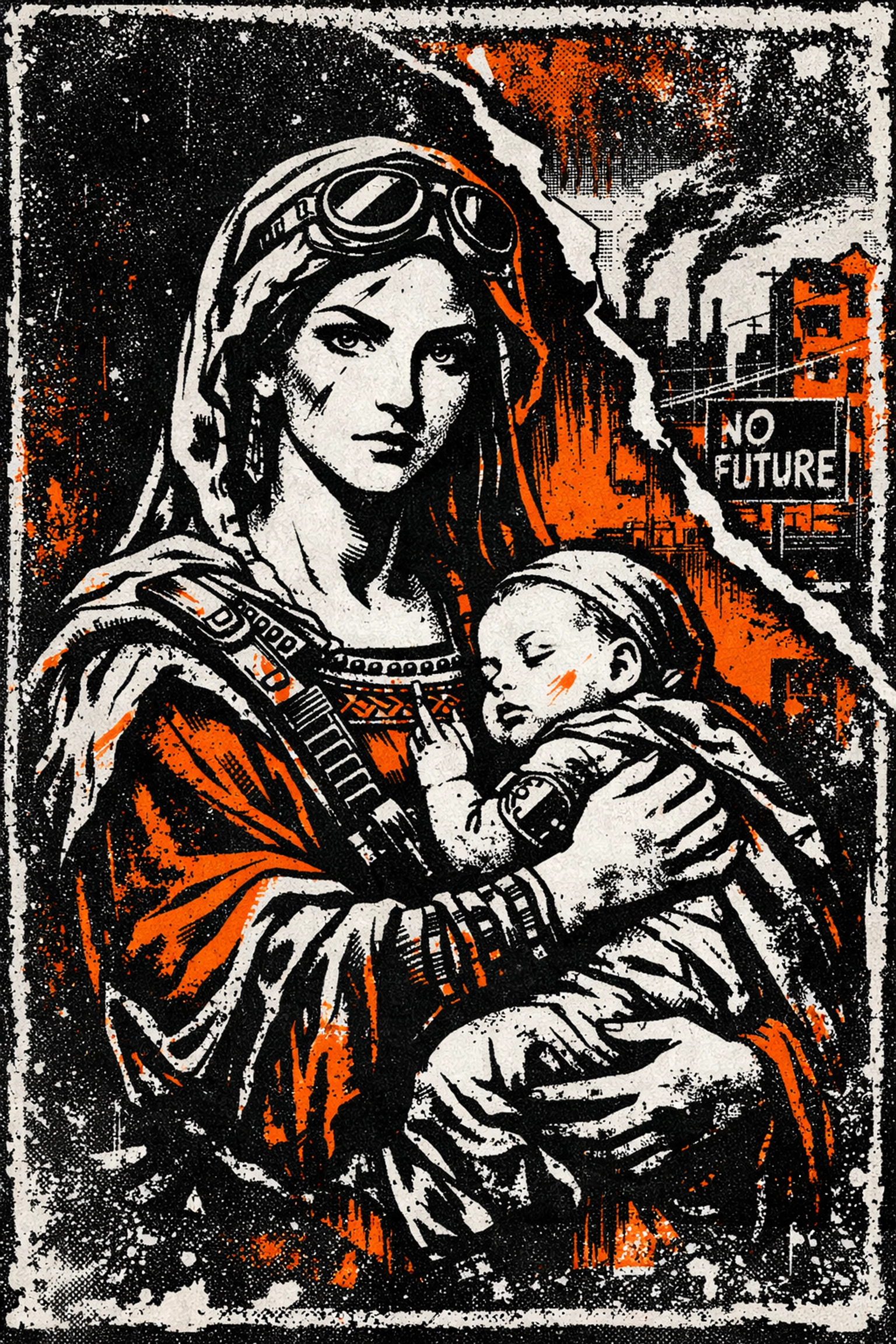
Image: historical painting of young mother with infant child | ALT: historical perspective on teen pregnancy across generations
A Story from Puerto Rico and Beyond
I gave my son examples from our own life. Our neighbors in Puerto Rico, who were also our landlords, started their family when they were fourteen. They didn’t have a safety net or a government agency holding their hands. They worked. They struggled. And they raised a large family of successful, hardworking, responsible adults.
Stories like that fly in the face of the modern narrative that says a teenage parent is a guaranteed “broken outcome.” Sometimes they are. But sometimes they aren't. Life is messy, and reality rarely fits inside the neat, ideological boxes politicians build for us.
Even the historical figures we hold in high regard lived by different rules. Mary, the mother of Jesus, is widely believed by historians and theologians to have been between 14 and 16 when she gave birth. In ancient cultures, starting a family early wasn't a “crisis”; it was the norm. Our modern assumptions aren't universal truths, they are cultural shifts.
Then there’s the global perspective. When I was in the Philippines recently, I talked to a taxi driver who told me, with zero fanfare, that he started his family at age twelve. TWELVE.
[Video: Taxi driver in the Philippines describing starting a family at age 12 | Note: Real world example of generational differences in responsibility and family norms]
https://www.youtube.com/shorts/0brhSYjq3qA
Different cultures have vastly different expectations of when “adulthood” begins. Those expectations shape how people view responsibility. If you're told you're a child until you're 25, you'll act like it. If you're told you're a man at 13, you'll step up.
Personal History: My Own Timeline
I wanted to be honest with my son about my own journey. I didn't want to give him a “do as I say” speech. I gave him the “this is what happened” facts.
- I had my first legal job at 14. It’s on the record because I paid Social Security taxes on it.
- I had my first apartment at 15.
- I was fully responsible for my own survival before I was legally allowed to drive a car alone.

Image: teenage worker at a small job site carrying tools | ALT: generational responsibility starting work at age 14
I told him: I wouldn’t have started a family back then. I actually waited intentionally until I was 27 to have kids. But I’m saying it’s not uncommon, and it’s not impossible.
We have to separate two distinct questions that people always mix up:
- Is abortion a reasonable response to rape?
- Is it “wrong” to have a baby at age fourteen?
Those are not the same issue. One is a question of moral response to trauma; the other is a question of biological and cultural capacity. When we mix them, we lose the ability to have a rational conversation about either.
The Institutional Critique
The reason we struggle so much with these topics today is that we’ve outsourced our accountability. We’ve handed our problems over to the state, the courts, and the bureaucracies. We’ve been told that we aren't capable of handling “hard things” on our own.
When you remove the expectation of personal responsibility, you create a vacuum of agency. You turn people into victims of their circumstances rather than masters of their fates. This is why some people see Hidden Scrolls and ancient wisdom as “dangerous”, because it reminds us that we used to be stronger, more resilient, and more accountable.
Older generations accepted responsibility earlier because they had to. Today, many people are financially dependent on their parents or the government well into their twenties. Neither model is perfect, but the shift has fundamentally changed how we answer moral questions. If adulthood starts “later,” then teenage pregnancy feels like an end-of-the-world scenario. If adulthood starts “earlier,” it feels like a difficult but manageable reality.

Image: young couple walking through a rural neighborhood with a baby stroller | ALT: accountability vs responsibility in generational family life
Conclusion: Agency over Victimhood
I’m glad my son asked me that brutal question. I’m glad he’s wrestling with the concept of eugenics vs. trauma vs. life. It means he’s thinking. It means he’s not just regurgitating the “correct” opinions he hears on social media.
Raising kids isn't about giving them all the answers. It’s about teaching them how to carry the weight of the questions.
Responsibility says your choices matter.
Accountability says you own the consequences.
Whether we are talking about work, family, or the most difficult moral dilemmas a human can face, the goal is always the same: Agency. We need to stop looking to systems to save us and start looking at how we can reclaim the ownership of our own lives.
Keep it real. Keep it disruptive.
, Ryan “Dickie” Thompson
Sources & References:
- U.S. Department of Health and Human Services (Adoption Statistics): https://www.acf.hhs.gov/cb
- CDC (Teenage Pregnancy Historical Data): https://www.cdc.gov/teenpregnancy
- Disruptarian Radio: Taxi Driver Interview YouTube Link
- The Ballad of the Great Awakening

Spun Web Technology SMART SEO