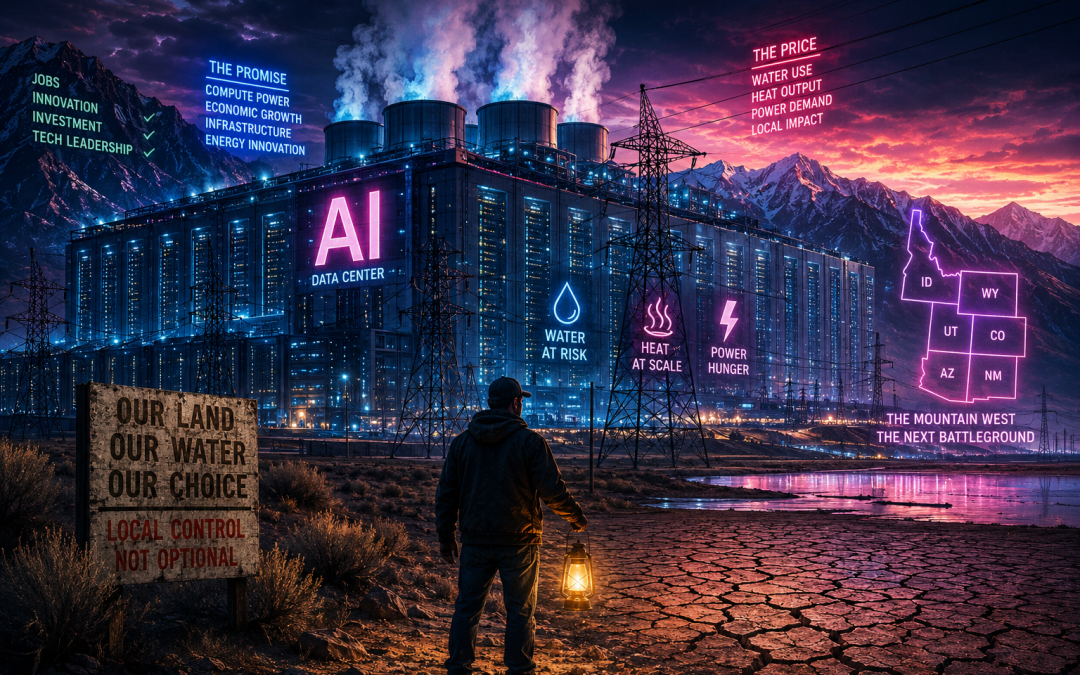
AI Data Centers in the Mountain West: Water, Heat, Power, and the Price of Progress
The Mountain West is becoming a front line in the AI boom.
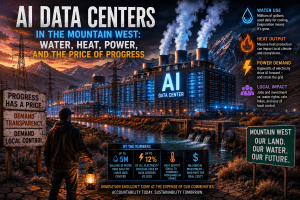
AI data centers bring compute power and investment to the Mountain West, but they also raise hard questions about water use, heat output, power demand, and who pays the price of progress.
Utah, Idaho, Nevada, Wyoming, Arizona, and parts of Colorado have what big tech and infrastructure firms want: land, energy corridors, open space, tax incentives, and political leaders who like growth. That mix makes the region attractive for massive AI data centers.
But there is a catch.
The same region also has drought, strained water systems, fragile desert ecosystems, fast population growth, and rural communities that do not want to wake up one morning and find out their county has become a server farm for Silicon Valley.
That is the conflict.
AI data centers are not evil. They are also not magic. They are physical buildings full of machines. They need land. They need power. They create heat. Many use water for cooling. They can bring jobs, taxes, fiber, and industrial investment. They can also shift costs onto locals if the rules are sloppy.
A free society should not fear technology. But it should also not give politically connected developers a blank check.
The real question is not, “Should AI data centers exist?”
The better question is this: Who pays the real cost, who gets the benefit, and who gets a say?
Why The Mountain West Is In The Crosshairs
AI needs compute. Compute needs data centers. Data centers need electricity, cooling, land, and transmission.
The Mountain West has become a target because it has large parcels of land, lower population density, access to energy development, and state governments that often market themselves as business-friendly. That makes sense from a market view.
But water is the hard limit.
The region already fights over rivers, aquifers, agricultural water rights, municipal growth, and the future of places like the Great Salt Lake. Data centers enter that fight as a new industrial user with deep pockets.
A 2026 Guardian investigation found that many proposed U.S. AI data centers are planned for drought-hit areas. It reported that 517 of 809 planned projects were located in areas suffering from prolonged drought. The same report said large facilities can use up to 5 million gallons of water daily, and national data center water demand may rise sharply by 2028. (The Guardian)
That does not mean every data center uses 5 million gallons per day. Many use far less. Some use closed-loop or air-based cooling. Some use reclaimed water. Some consume almost no water on-site after initial fill. But the public backlash is not crazy. People are reacting to a real resource problem.
In the desert, water is not just an input. It is political power.
The Water Problem Is More Complicated Than People Think
Most people hear “AI uses water” and imagine servers drinking from a pipe.
That is not exactly how it works.
Data centers use water mainly for cooling. Servers create heat. That heat must go somewhere. In many systems, water absorbs the heat and then releases it through cooling towers. Some of that water evaporates. Once it evaporates, it is no longer available to that local water system.
Other facilities use closed-loop cooling. Water or another fluid circulates through the system, pulls heat away from equipment, and keeps being reused. These systems can reduce water use, but they may cost more and can use more electricity depending on design.
Then there is indirect water use.
If a data center pulls huge amounts of power from the grid, and the power plants serving that grid use water for steam or cooling, then the data center has a water footprint even if the facility itself looks clean. This is the part often left out of press releases.
The Environmental and Energy Study Institute says large data centers can consume up to 5 million gallons of water per day, equal to the water use of a town of 10,000 to 50,000 people. It also notes that AI-focused data centers are increasing water consumption along with energy demand and carbon emissions. (EESI)
This is why local disclosure matters.
A company saying “we are water efficient” is not enough. Residents need numbers. How much potable water? How much reclaimed water? How much evaporates? How much is discharged? What happens in drought years? What happens during phase two and phase three?
The fine print matters more than the ribbon cutting.
Heat Is Not Just A Talking Point
Data centers turn electricity into computation, and much of that energy ends up as heat. That is basic physics.
The question is whether the heat is a local nuisance, a regional climate problem, or a manageable engineering issue. The answer depends on scale, design, and location.
A small data center is one thing. A multi-gigawatt campus is something else.
Utah’s Stratos project in Box Elder County became a national flashpoint because of its proposed scale. Reports said the project was first described as a 40,000-acre development with possible power demand between 7.5 and 9 gigawatts. After public pressure, Kevin O’Leary agreed to reduce the project footprint and set aside land near the Locomotive Springs area. (Business Insider)
That kind of size invites hard questions.
Where does the heat go? Does it affect nearby farms, wildlife areas, neighborhoods, or the Great Salt Lake ecosystem? Does the project create a heat island? Are there enforceable heat limits? Can waste heat be reused for greenhouses, industrial processes, or district heating?
Developers often say heat fears are exaggerated. Sometimes they are right. Not every server farm becomes a desert furnace. But citizens are also right to ask for independent modeling before approval, not after construction.
Markets work best when information is public and risk is priced honestly.
Power Demand: The Hidden Taxpayer Risk
Water gets the headlines. Power may be the bigger fight.
AI data centers need steady electricity. Not a little. A lot.
The Lawrence Berkeley National Laboratory has tracked rising U.S. data center power use, and Consumer Reports cited that work in warning that data centers could use 12 percent of U.S. electricity by 2028. (Consumer Reports)
That kind of load can stress the grid. It can require new transmission lines, substations, gas plants, solar farms, batteries, nuclear projects, or geothermal systems. None of that is free.
Here is the libertarian concern: If a private company wants massive power, fine. But existing ratepayers should not be forced to subsidize it through higher bills, hidden utility costs, or political deals.
Idaho has already seen concern about this issue. BoiseDev reported on a bill aimed at stopping large data center customers from raising electricity rates on everyone else. The bill targeted new customers or businesses requiring 20 megawatts or more. (BoiseDev)
That is a fair debate.
A free market is not when a giant firm gets special rates, public infrastructure, tax breaks, and water access, while the local family sees higher utility bills. That is not capitalism. That is cost shifting.
If the project needs new power, the developer should pay the true cost. If the project brings its own power, even better, but local air quality, fuel use, and backup generation still matter.
Utah: The Stratos Shock And The New Rules
Utah is now the test case.
The Stratos proposal triggered backlash because it was huge, fast-moving, and tied to a governance structure that many residents saw as too centralized. A lawsuit was filed against the project by residents and Alliance for a Better Utah, challenging the role of the Military Installation Development Authority in local land use and public input. (The Guardian)
Utah Governor Spencer Cox responded by issuing an executive order in May 2026 that created a tougher statewide framework for large data center projects. Reports said the order focused on water resources, air quality, utility ratepayers, wildlife, public engagement, and protection of the Great Salt Lake. (Business Insider)
That is where things get interesting.
A pro-growth state is not saying “no data centers.” It is saying, “prove it.”
Prove the water plan. Prove the power plan. Prove locals will not carry the cost. Prove the project can scale without wrecking the area around it.
That is not anti-business. That is adult supervision.
Utah also has the Delta Gigasite in Millard County, where Joule Power says it is building a 4,000-acre AI data center campus. The company says the project is planned for 12 gigawatts and describes phase one as over 1 gigawatt, with behind-the-meter power to avoid grid constraints. (Joule Power AI)
That may be the future: massive compute tied directly to new energy generation. But even then, the public needs real disclosure. “Behind the meter” does not automatically mean “no local impact.”
Idaho: Farmland, Federal Land, And The Next Fight
Idaho is not as loud as Utah yet, but the same conflict is forming.
Meta announced Kuna, Idaho, as the site of a major data center in 2022. The state said the facility would be over 960,000 square feet, with about 100 operational jobs and more than 1,200 jobs at peak construction. (Idaho Commerce)
The problem is that Kuna is farm country. Growth already pressures roads, water, housing, and agriculture. A giant data center changes the land economy. Farmers can be priced out. Counties may love the tax base. Neighbors may hate the noise, traffic, and industrial feel.
BoiseDev reported that Meta’s Kuna project has multiple phases, with the first phase using air cooling and a later phase using water. (BoiseDev)
That is exactly why phased approval matters. Phase one may look harmless. Phase two may change the water math.
In Pocatello, Lex Developments proposed turning the former Hoku Materials plant into a $2.6 billion AI data center. BoiseDev reported the proposal in May 2026, and local reports said the project drew a large public hearing. (BoiseDev)
There is a good argument for reusing old industrial sites. It can reduce pressure on farmland and use land that already has infrastructure. But locals still deserve hard numbers on electricity, water, heat, noise, fire risk, tax treatment, and long-term jobs.
Then there is the federal angle.
The U.S. Department of Energy opened a process for AI data center and energy projects at Idaho National Laboratory. DOE said about 44,000 acres had been identified for possible AI infrastructure, with priority for projects that integrate advanced nuclear, enhanced geothermal, or underground thermal storage. (The Department of Energy's Energy.gov)
This could be a smart way to pair data centers with serious energy innovation. It could also become another case where federal land is used to speed around local concerns.
The principle should be simple: public land does not mean public silence.
The Case For Massive AI Data Centers
There are real benefits.
First, AI infrastructure matters for national competitiveness. Compute power is now part of finance, logistics, medicine, defense, energy modeling, education, manufacturing, agriculture, and cybersecurity. A country that cannot build compute infrastructure will depend on countries that can.
Second, data centers can bring capital into rural areas. Construction jobs are real. Tax revenue is real. Fiber expansion is real. Industrial power development can help a region if it is built right.
Third, data centers may push energy innovation. Nuclear, geothermal, gas with carbon controls, solar, batteries, and advanced cooling are all being tested because AI demand is forcing the issue. The Mountain West has energy resources and open land that can support that.
Fourth, some projects may be cleaner than critics claim. Closed-loop liquid cooling, direct-to-chip cooling, air cooling in cold climates, reclaimed water, and waste heat reuse can reduce the footprint. The technology is improving fast.
A serious person should admit this.
You cannot demand American tech leadership and then oppose every factory, mine, power line, and data center needed to support it.
The Case Against Blank-Check Data Centers
The risks are just as real.
First, water rights can be distorted by money. If tech firms buy or lease water rights in dry regions, farms and communities may lose out. Even when the legal transaction is clean, the social impact can be ugly.
Second, grid costs can be socialized. If utilities build infrastructure for one giant customer, regulators must make sure normal ratepayers are not stuck with the bill.
Third, local control can be bypassed. Special districts, state authorities, emergency approvals, and tax deals can silence residents. That creates backlash, and it should.
Fourth, job numbers can be oversold. Data centers create many construction jobs, but permanent jobs are often modest compared to the land, water, and power involved.
Fifth, environmental promises can be vague. “Sustainable,” “green,” and “water positive” sound nice. They mean nothing without enforceable contracts, public reporting, penalties, and third-party audits.
This is where libertarians should be sharp. Property rights matter. Contracts matter. Local consent matters. Externalized costs are not free market outcomes. They are political outcomes.
A Better Standard: Build It, But Price It Honestly
The Mountain West does not need panic. It needs rules that respect property, water, energy, and local communities.
Here is a better standard.
Require full water disclosure before approval. Not slogans. Numbers.
Require phase-by-phase permits. A project should not get approval for a small first step and then quietly expand into a regional resource monster.
Require developers to pay for grid upgrades tied to their load.
Require no net increase in potable water use in stressed basins unless the developer brings new water, reclaimed water, or verified offsets that actually help the same watershed.
Require heat, noise, and air quality modeling from independent engineers.
Require public hearings in the affected county, not just state-level approvals.
Require tax deals to be public.
Require decommissioning bonds so abandoned projects do not become public liabilities.
None of this bans data centers. It just makes the deal honest.
The Disruptarian View
AI data centers are not the enemy. Crony infrastructure is the enemy.
There is a path where the Mountain West becomes a hub for compute, energy innovation, nuclear deployment, geothermal development, and high-value infrastructure. That path could bring wealth and resilience.
There is also a path where rural counties become sacrifice zones for politically connected megaprojects. That path brings resentment, lawsuits, water fights, and higher utility bills.
The difference is consent.
If developers can prove their water use, pay for their power, respect local control, and accept real liability, then build. Let private capital work. Let innovation compete.
But if the plan depends on secrecy, subsidies, ratepayer risk, vague water promises, or state-level muscle against local citizens, then call it what it is.
Not progress.
Just another machine feeding off the public.
The Mountain West should not reject the future. It should make the future pay its own way.
WordPress Excerpt
20 Keywords
AI data centers in the Mountain West, Mountain West data centers, Utah AI data centers, Idaho AI data centers, data center water use, AI water consumption, hyperscale data centers, data center heat, data center cooling, Great Salt Lake data centers, Stratos data center, Box Elder County data center, Kuna Idaho data center, Pocatello AI data center, data center energy demand, AI infrastructure, water rights, local control, free market technology, data center power use
Sources
- Majority of US’s new AI datacenters to be built on drought-hit land|https://www.theguardian.com/us-news/2026/jun/08/datacenter-ai-drought-water
- Kevin O’Leary agrees to cut the size of his data center in half after backlash|https://www.businessinsider.com/kevin-oleary-data-center-project-smaller-2026-6
- Suit filed against controversial planned Stratos datacenter project in Utah|https://www.theguardian.com/us-news/2026/jun/06/stratos-datacenter-utah-suit
- Kevin O’Leary agrees to downsize massive Utah data center|https://www.theverge.com/ai-artificial-intelligence/943234/kevin-oleary-agrees-to-downsize-massive-utah-data-center
- Utah governor just tightened the rules for Kevin O’Leary’s giant AI data center|https://www.businessinsider.com/utah-data-center-kevin-oleary-stratos-backlash-new-rules-governor-2026-5
- Utah governor issues order to protect Great Salt Lake, air and ratepayers|https://www.sltrib.com/news/environment/2026/05/29/utah-governor-issues-order-protect/
- Data Centers and Water Consumption|https://www.eesi.org/articles/view/data-centers-and-water-consumption
- AI, data centers, and water|https://www.brookings.edu/articles/ai-data-centers-and-water/
- 2024 United States Data Center Energy Usage Report|https://escholarship.org/uc/item/32d6m0d1
- AI Data Centers Impact on Electric Bills, Water, and More|https://www.consumerreports.org/data-centers/ai-data-centers-impact-on-electric-bills-water-and-more-a1040338678/
- Joule Power AI Data Centers Free from Grid Constraints|https://joulepower.ai/
- BetterGrid Campus by Joule Power|https://joulepower.ai/campus-page/
- Meta Announces Kuna as Location of New Data Center|https://commerce.idaho.gov/press/meta-announces-kuna-as-location-of-new-data-center/
- How much water will Kuna’s data centers use?|https://boisedev.com/news/2026/03/20/data-center-water/
- Another large Idaho data center proposed, valued at $2 billion plus|https://boisedev.com/news/2026/05/14/lex-portneuf-data-center/
- Proposal of Pocatello AI Data Center Draws Crowd at Public Hearing|https://www.ktvb.com/article/tech/we-need-hard-numbers-proposal-of-pocatello-ai-data-center-draws-crowd-at-public-hearing/277-4635f699-59c2-40f3-a9ce-e3f8533706de
- Energy Department Seeks Proposals for AI Data Centers, Energy Projects at Idaho National Laboratory|https://www.energy.gov/ne/articles/energy-department-seeks-proposals-ai-data-centers-energy-projects-idaho-national

Spun Web Technology SMART SEO