By Ryan “Dickie” Thompson, reporting from Disruptarian Radio
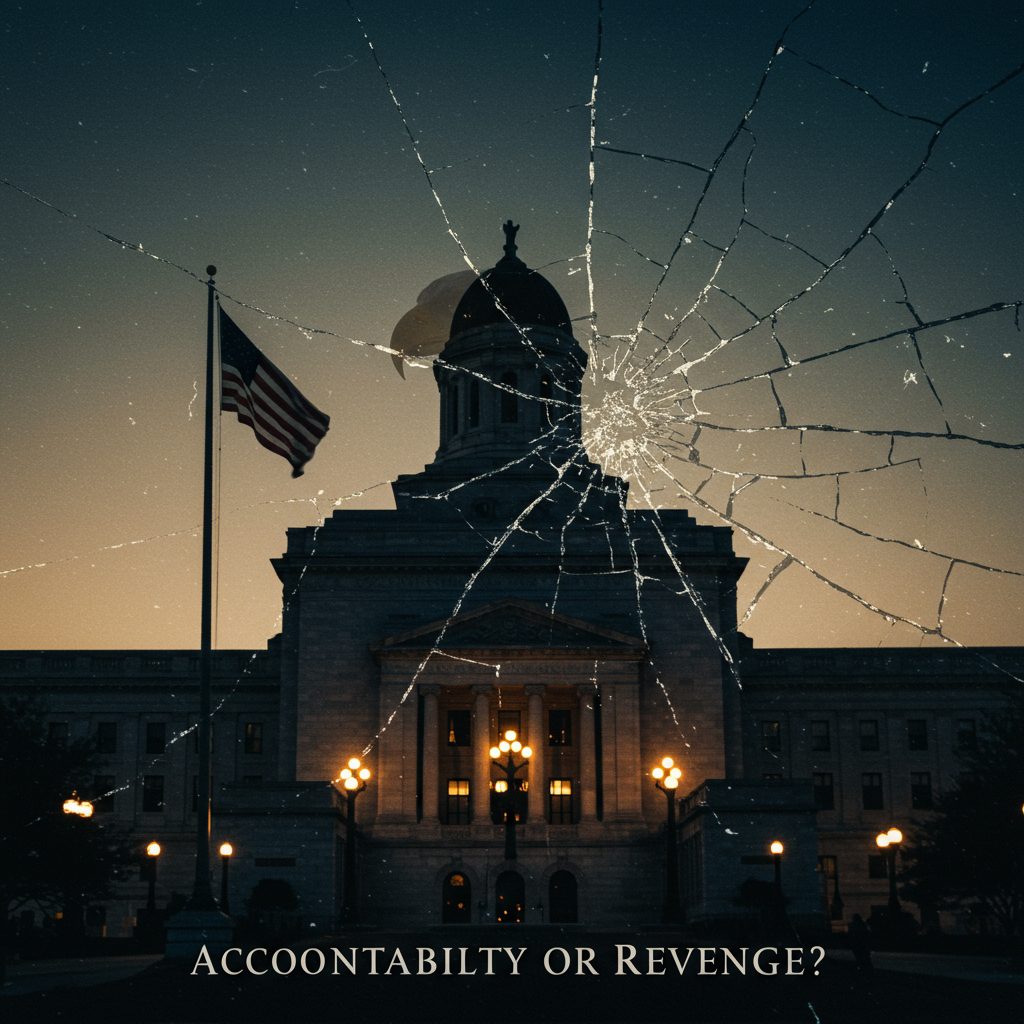
You wake up one morning and the institutions you thought were walls start looking like glass. That glass sometimes shatters in tiny, polite pieces. Sometimes it falls out of the window and you see the street below. The indictment of former FBI director James Comey is the latest crack. It is not just another headline. It is a story about power, hypocrisy, and the rules that were supposed to protect us from men who think they are above the law.
Let me be clear: this is not a celebration of lawlessness. It is an argument for consistency. If Comey lied under oath, if he weaponized the nation’s most powerful law enforcement agency in a partisan way, then he should face the same legal standards anyone else would. That is the principle that should have guided events from the beginning. Instead, what we got for years was selective outrage and the kind of moral hierarchy that says some people get special treatment because they wore a badge, or sat in a nicer chair, or pushed a story the correct way.
The indictment, announced by the Department of Justice, accuses Comey of lying to Congress and obstruction related to how the FBI handled the Russia probe and related leaks. The DOJ’s own press release confirms the charges. (Department of Justice)
This moment has exposed two clear truths. One, institutions will obey politics when the incentives align. Two, the crowd that howled the loudest about so-called rule of law in 2016 and 2017 is the same crowd that now looks away when the law reaches its political enemies. You do not restore faith in the rule of law by playing partisan ping pong with prosecutors. You restore it by applying the law equally. That is what some are trying to sell as retribution, and others are calling justice. There is a difference. But it is a difference that gets blurred when every move has a political script.
Fox News’ Jesse Watters was blunt about the difference between how the media and the political class treated Trump and how they treated those who targeted him. Watters argued that when an FBI director lies to Congress, he lies to the American people and should face consequences. He also framed this indictment as the start of a broader accountability sweep aimed at officials who, in his view, weaponized the justice system. That commentary, raw and unapologetic, captures a sentiment many conservatives feel: for years, a set of powerful people were allowed to break norms while the public looked on. Now, finally, there is pushback. (Fox News)
I do not expect the cable news echo chamber to settle the legal merits. That is what the courts are for. But let us not pretend the public reaction happens in a vacuum. The court of public opinion has been hearing decades of stories about selective prosecutions, leaks, and the politicization of intelligence agencies. Those stories create a climate where a Comey indictment moves at lightning speed from legal document to political lightning rod.
Legal analysts have already weighed in, and not all of them think this case will hold up. Some reputable outlets warn that the indictment is thin on direct evidence and that the prosecutor handling the case is a recent political appointee with little trial experience. That matters. You do not want convictions based on overreach. You do not want prosecutions that look like political theater. That will erode confidence just as fast as unchecked power did. The Politico piece on the case lays out concerns about evidentiary gaps and the way this prosecution came together. (Politico)
But let us not let technical doubts become an excuse for moral cowardice. If the FBI was weaponized, if investigations were spun to achieve political ends, if careers and reputations were ruined because someone in power wanted a result, then accountability is required. Accountability should not be binge justice, it should be institutional. Strip privilege where privilege exists. Reinforce neutral rules. Prosecute clearly proven crimes. That is how you rebuild trust.
There is also a cultural story here. Remember President Trump’s inauguration day, when cameras caught Barack Obama leaning in to whisper something to George W. Bush? Some online sleuths and a prominent lip reader claimed Obama asked Bush, “How can we stop what’s happening.” That moment went viral, and conservative outlets pounced. Lip readers are not perfect. They can be suggestive, not definitive. But the symbolic value of that clip was enormous. It crystallized a suspicion among many Americans that political elites were plotting behind the curtains to block a political outsider they saw as dangerous. Whether the words were precisely that or not, the public reaction was telling. It was a narrative that drove a lot of political energy in the years that followed. You can see coverage of that lip reading in outlets that tracked the viral clip. (New York Post)
Here is the uncomfortable truth: when the system is used to bend norms to political ends, people lose faith. They do not just turn away from one party. They turn away from the institution. And when that happens, power vacuums form. Those vacuums are filled, not by virtue, but by force and raw politics. That is the cliff we are standing on now. This indictment did not create the cliff. It exposed where people had been pushing us toward it.
Now for arguments you will hear on cable and in the halls of power. One side will say this is revenge. They will point to the rush of prosecutions and call it tit for tat. The other side will say this is justice, finally catching up to people who think they are untouchable. Both sides present a version of reality that is incomplete.
Revenge is a terrible motive for law. If Trump milks prosecutions for political gain, that corrupts the justice system. But if the law is applied selectively, favoring one political tribe over another for years, you cannot pretend you are surprised when the other tribe pushes back. The real solution is structural: restore prosecutorial independence, protect career civil servants from political firing squads, stop replacing career U.S. attorneys with cronies on the eve of investigations, and make the rules clear.
There are also practical risks to the way this comes down. The Politico analysis warns the case may collapse under scrutiny, creating a spectacle that undermines legitimate claims. If the indictment fails, if procedural errors rush it into dismissal, the result will be twofold. First, Comey will be vindicated in the public eye to a degree. Second, those who demanded accountability will feel validated in their suspicion that the “deep state” protected its own. Neither outcome rebuilds trust.
We should also talk honesty. The players on both sides have stories that do not always add up. Tax returns, withheld memos, leaks, and media narratives have formed a fog where simple facts are hard to find. That was on full display in the media coverage following the indictment, with outlets ranging from Fox to The Guardian spinning very different frames. The Guardian notes the political theatre and potential fallout of politicizing the DOJ, while Fox frames this as long overdue accountability. Both are right in parts. Both are dangerous if they refuse to accept nuance. (The Guardian)
Let us set a baseline: no one is above the law. That includes James Comey, Donald Trump, and every official who picks up a badge. But you do not build a republic by weaponizing the courthouse for a political score. You build it by enforcing rules equally. That means rigorous independent prosecutors, impartial judges, and a press that demands facts more than narratives. That is what Disruptarian Radio argues: freedom is not an abstract claim. It is a set of institutions and habits that support impartial law, private rights, and a society where power is constrained.
What comes next? Expect a political firestorm. Expect loud rhetoric about revenge, justice, and the end of the Republic. Expect soft-jurisdiction judges to be accused of bias, and for partisan operatives to declare victory before trials begin. Expect both sides to try to make the legal process into a tool for political gain. And expect ordinary citizens to feel increasingly alienated.
Here is the concrete policy prescription you will not hear shouted about on cable. First, require that DOJ decisions on politically sensitive cases go through a panel of career prosecutors who must sign off publicly, with clear reasons. Second, protect whistleblowers and career staff who raise concerns about politicization. Third, create fast, transparent reviews of any law enforcement action that targets political actors. These are not radical ideas. They are checks against the natural tendency for those in power to stay in power.
Finally, to my listeners who are tempted to cheer or jeer purely on partisan grounds: stop. This is not a sports match. It is not a reality show. It is the future of your country. If you want justice, demand it regardless of the name on the indictment. If you want stability, insist on neutral rules that survive the next angry election. If you want liberty, do not accept a system where the rule of law is only enforced when it suits the calendar.
James Comey’s indictment is a test. It will tell us whether our institutions can be held accountable without being turned into weapons. It will tell us whether the rule of law is a principle or a slogan. It will tell us whether the next generation inherits a system that enforces the law fairly or inherits a permanent civil war of prosecutions.
I am not naive about the outcome. The political appetite for vengeance is real. The temptation to use a courtroom as a gavel is strong. But neither of those temptations is compatible with liberty. The right response is not to cheer because your team scores. It is to demand a system that treats everyone the same.
If that sounds boring, good. Boring is what keeps the trains running. Boring is what keeps the law neutral. Boring preserves freedom. If you want real change, push for boring reforms that constrain power, protect the innocent, and hold the guilty accountable—no matter where they sit.
This indictment is only the beginning of a national conversation. Make sure your side of that conversation is about rules and not revenge. If we let the courthouse become a battlefield, then the rest of us will pay the price.
Sources
- Department of Justice press release on Comey indictment. (Department of Justice)
- Politico analysis: Why the case against James Comey may face serious legal hurdles. (Politico)
- Fox News coverage and Jesse Watters commentary on the indictment. (Fox News)
- NY Post report on lip reader claiming Obama said “How can we stop what’s happening” at Trump’s inauguration. (New York Post)
- Newsweek and other outlets covering the lip reading viral clip. (Newsweek)

Spun Web Technology SMART SEO