


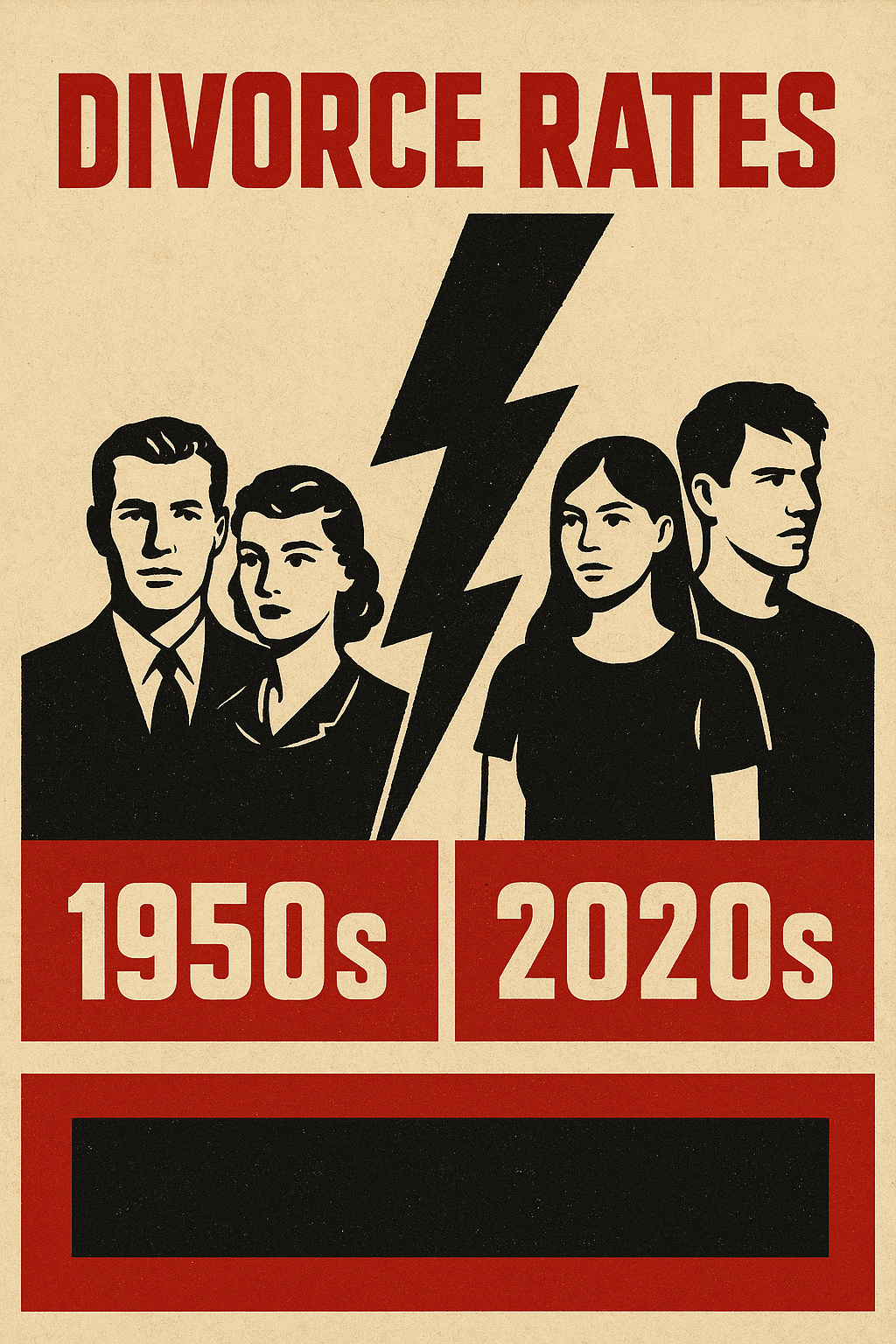
To understand how Western relationships have collapsed, you have to compare two eras: the 1950s and the 2020s. One generation saw stable marriages as the norm. The other sees divorce as practically inevitable. What changed?
The 1950s marriage model
In the 1950s, marriage was practically universal. People married young, often in their early 20s. Divorce was rare, stigmatized, and legally difficult. Families were built around loyalty and responsibility, not convenience.
- Men worked and provided.
- Women raised children and managed households.
- Communities reinforced marriage as the foundation of life.
It wasn’t perfect. There were unhappy marriages and limited options for women who wanted independence. But the stability was undeniable. Children grew up in two-parent homes. Divorce rates were low. Marriage was seen as permanent.
The rise of no-fault divorce
Fast forward to the 1970s. Western governments introduced “no-fault divorce.” Suddenly, anyone could walk away from a marriage without proving wrongdoing. The floodgates opened. Divorce rates skyrocketed. By the 1980s, nearly half of all marriages ended in divorce.
The legal shift sent a cultural message: marriage isn’t permanent, it’s optional. If it gets tough, you don’t work it out—you file the papers.
The 2020s marriage crisis
Today, the fallout is clear. Fewer people are marrying at all. Those who do often delay it into their 30s. Cohabitation replaces commitment. Children are increasingly raised in single-parent homes or blended families.
And the divorce rate? It’s lower now than in the 1980s, but that’s because fewer people are marrying. Cohabiting couples break up at even higher rates, but the state doesn’t count those splits. The stability of the 1950s is gone, replaced by relationship roulette.
Why it matters
Marriage isn’t just a personal choice—it’s the foundation of a healthy society. Strong marriages mean stable families. Stable families mean resilient communities. When marriage collapses, society weakens.
Compare outcomes:
- Children of intact families have better education, lower crime rates, and stronger futures.
- Children of broken homes face higher risks of poverty, depression, and instability.
- Communities with stable marriages have lower welfare dependency and stronger economies.
The 1950s weren’t perfect, but the structure worked. The 2020s are “free,” but the freedom comes with chaos.
What we lost
We lost the cultural expectation that marriage was sacred. We replaced it with an attitude that relationships are temporary. We lost the legal protections that once discouraged frivolous divorce. And we lost the idea that responsibility outweighs personal convenience.
Now, people enter relationships with one foot out the door. They don’t trust marriage to last. They don’t see family as worth the sacrifice. And the state—through welfare programs and family courts—often makes it easier to leave than to stay.
What we can learn
We don’t need to copy the 1950s. Women deserve freedom and independence. Men deserve fairness in family law. But we can learn from the past:
- Marriage must mean something again.
- Responsibility has to outweigh convenience.
- The state should stop incentivizing family breakdown.
Closing thought
The 1950s were far from perfect, but they built families that lasted. The 2020s glorify choice and freedom, but they leave us lonely and unstable. The lesson isn’t to turn back the clock—it’s to reclaim what worked: commitment, responsibility, and the idea that family is worth fighting for.
If we don’t, the next generation won’t just compare the 1950s to the 2020s. They’ll be comparing a society with families to one without them.
- Divorce: More than a Century of Change, 1900–2022 – Historical data on divorce trends in the U.S. Bowling Green State University
- The Evolution of Divorce (National Affairs) – 1950s vs 1970s divorce rates comparison. National Affairs
- How Has Marriage in the US Changed Over Time? (USAFacts) – Gives percentages of divorce in 1950 vs 2024. USAFacts
- Marriage and Divorce Since World War II – Economic modeling of marriage patterns over time. NBER Users
- Divorce Decline: About 40% of Today’s Marriages Will End in Divorce – Recent findings on marital stability since the 1950s. Institute for Family Studies
This is part of a 5 part series on modern relationships between men and women (real men, and real women)
Part 1: Men in the Modern West
- How men lost their traditional roles as providers/protectors
- The collapse of purpose: passivity, dominance, or online bitterness
- What true masculinity means today (integrity, resilience, direction)
- Impact of state interference and fear of divorce courts
- Call to action for men to take responsibility and build strength
Part 2: Women in the Modern West (scheduled for September 10th 2025)
- The false promise of “having it all” (career, independence, family later)
- Biology vs ideology: fertility realities ignored by culture
- Loneliness epidemic despite career success
- The myth of independence leading to isolation
- Re-centering respect, cooperation, and family priorities
Part 3: The State, Society, and the Breakdown of Trust (scheduled for September 11th 2025)
- How marriage became a government contract instead of a personal bond
- No-fault divorce and the legal incentives to break families
- Cultural poison: men labeled toxic, women told commitment is settling
- Dating apps and the “marketplace” mentality of relationships
- Libertarian perspective: kick the state out, rebuild trust through responsibility
Part 4: Age Gap Dating – West vs East (scheduled for September 12th 2025)
- Western stigma against older men dating younger women
- Biological attraction vs ideological resistance
- Why Southeast Asia and other cultures accept age gaps
- Economic and cultural practicality in non-Western contexts
- Libertarian take: consenting adults should be free to choose
Part 5: Divorce Rates – 1950s vs 2020s (scheduled for September 13th 2025)
- Stable marriages and social norms of the 1950s
- The rise of no-fault divorce and its impact on family breakdown
- 2020s reality: fewer marriages, higher instability, more single-parent homes
- Consequences for children and communities
- Lessons to reclaim: responsibility, loyalty, and family as the foundation of society

Spun Web Technology SMART SEO