


We’ve all heard the mantra: “Step up and be a father.”
It echoes through public discourse, courtroom lectures, social media shaming, and family therapy offices. And while accountability is crucial, we rarely ask the more uncomfortable but vital question: What does it even mean to “be a father” in a system where paternity doesn’t always equal parental rights?
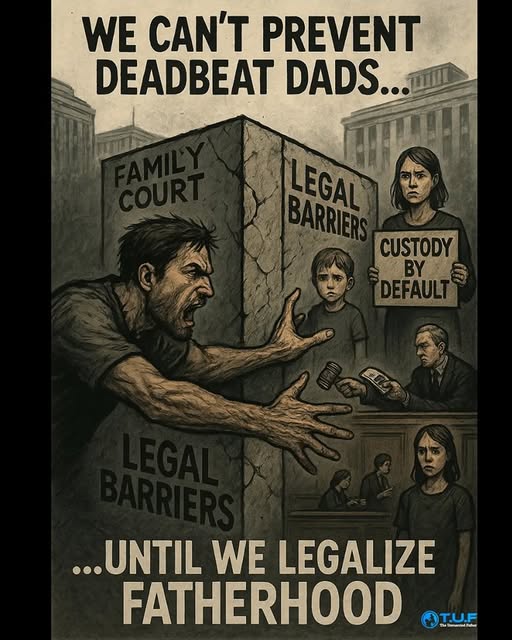
The truth is—you can’t fix deadbeat dads until you make fatherhood legal.
Not romanticized.
Not symbolic.
Legal.
Because if a father has no recognized legal authority over his child—no shared custody, no presumption of fairness in disputes, no standing in court unless he jumps through flaming hoops—then blaming him for being absent is not just unjust… it’s disingenuous.
This article explores why fatherhood must be legalized before we can solve the deeper crisis of absent or disengaged dads, and how the modern custody and family law system may be creating the very outcomes it claims to oppose.
The Illusion of Choice: When Fatherhood Is Conditional
Imagine signing a birth certificate, participating in parenting, contributing financially and emotionally—and still being considered a “visitor” in your child’s life.
For many fathers, particularly those unmarried at the time of their child’s birth, this is the default legal reality. In many jurisdictions, especially across Western countries, unmarried mothers are granted automatic sole custody, while fathers must petition, prove, and plead for rights to their own children.
In the case files referenced here—while identities remain confidential—a joint custody agreement was proposed only after a long history of denied access, international legal complexity, emotional disputes, and personal sacrifice. The father in this case was told: “Sign the birth certificate, but don’t expect shared rights.”
What kind of message does that send?
That fatherhood is welcomed when convenient, and disposable when not.
From Provider to Bystander: The Evolution of a Broken System
Society still expects men to “be there,” emotionally, financially, physically. Yet the same system that expects this also blocks access, refuses fair custody, and too often treats fatherhood as secondary—even transactional.
From courtrooms to immigration offices to family interventions, a pattern emerges:
- Fathers pay child support, but are denied custody.
- Fathers attend births, but aren’t consulted on school, medical, or religious decisions.
- Fathers are expected to relocate, but face barriers when seeking consistent visitation.
So what happens?
Some leave.
Some fight until they’re emotionally bankrupt.
Some stay and become emotionally detached, afraid to challenge or speak up.
And then—they're called “deadbeat.”
The Cultural Double Standard
This issue is further compounded by cultural narratives that romanticize motherhood while vilifying fatherhood. A mother struggling with parenting is “overwhelmed.” A father asking for joint custody is “controlling.”
According to the CDC and Pew Research Center:
- In 2022, 24% of U.S. children lived in fatherless homes.
- Over 50% of Black children and 31% of Hispanic children are being raised without their fathers in the household.
- Yet among non-custodial fathers, only 22% have any form of shared or joint custody.
Even Psychology Today reported in their article “The Never-Married: A New Normal” that a growing number of men are avoiding long-term relationships altogether—partly due to the fear of becoming legal strangers to their own children.
If we want those statistics to improve, we need to stop framing custody as a power struggle and start framing it as a parental right—for both parents.
What Legalizing Fatherhood Looks Like
So what does “legalizing fatherhood” really mean?
It means presumption of joint custody at birth when both parents are known and involved.
It means making it easier for fathers to assert their rights, not harder.
It means family law should default to shared parenting—unless proven otherwise with clear evidence of harm or neglect.
It means:
- Equal opportunity to make decisions
- Equal time with the child
- Equal respect in parenting roles
The custody agreement reviewed here (from the file Custody Agreement Version 3) lays out a model of shared time—six months each, virtual visitation, and mutual respect. But the fact that it took years of conflict, emotional strain, and legal action to get no where, shows how hard it is.
It was simple, she beckoned me to come out and be a father to my daughter.
When I got there, she had me put my name on the birth certificate, and then it abruptly ended, and also without me having access to my daughter.
This is how the journey began (a video that I filmed before going out to Ireland)
Too many fathers don’t get that far. They give up. Or they’re shut out entirely.
And then we wonder why we have a fatherhood crisis.
The Human Cost: Emotional and Developmental Fallout
Children need both parents.
Not just child support from dad and bedtime stories from mom.
They need dad's voice in their decisions. His discipline. His presence. His consistency. Children with active fathers are statistically:
- 2x more likely to graduate high school
- 80% less likely to end up in jail
- More emotionally resilient
Yet our family courts often treat fathers as optional accessories rather than fundamental parts of a child’s life.
The irony?
By denying legal access to capable fathers, we create the very absenteeism we claim to fight.
The Solution Is Simpler Than We Admit
We don’t need more propaganda campaigns.
We don’t need more moral shaming of men.
We don’t even need new laws—we need to enforce fairness with the laws we already have.
What we need is:
- Automatic shared custody as a legal starting point
- Respect for paternal rights across borders and jurisdictions
- Real consequences for parental alienation and gatekeeping
- The normalization of co-parenting, even without marriage
Let’s stop punishing fathers who want to be involved.
Let’s stop using fatherhood as leverage in disputes.
Let’s stop acting as if biology doesn’t matter when it comes to dad.
Final Thoughts: A New Paradigm for a New Generation
Until fatherhood is legally recognized and socially respected from the moment a child is born, we will continue to see more men walk away—some by force, some by fear, some by fatigue.
But it doesn’t have to be this way.
As a culture that claims to care about children, we need to prove it by honoring both of their parents—not just the one who wins custody by default.
Let’s not ask another man to “step up” until we give him something solid to step into.
And let’s never again call a man “deadbeat” when the system itself refuses to let him be a dad.

