


By Ryan “Dickie” Thompson
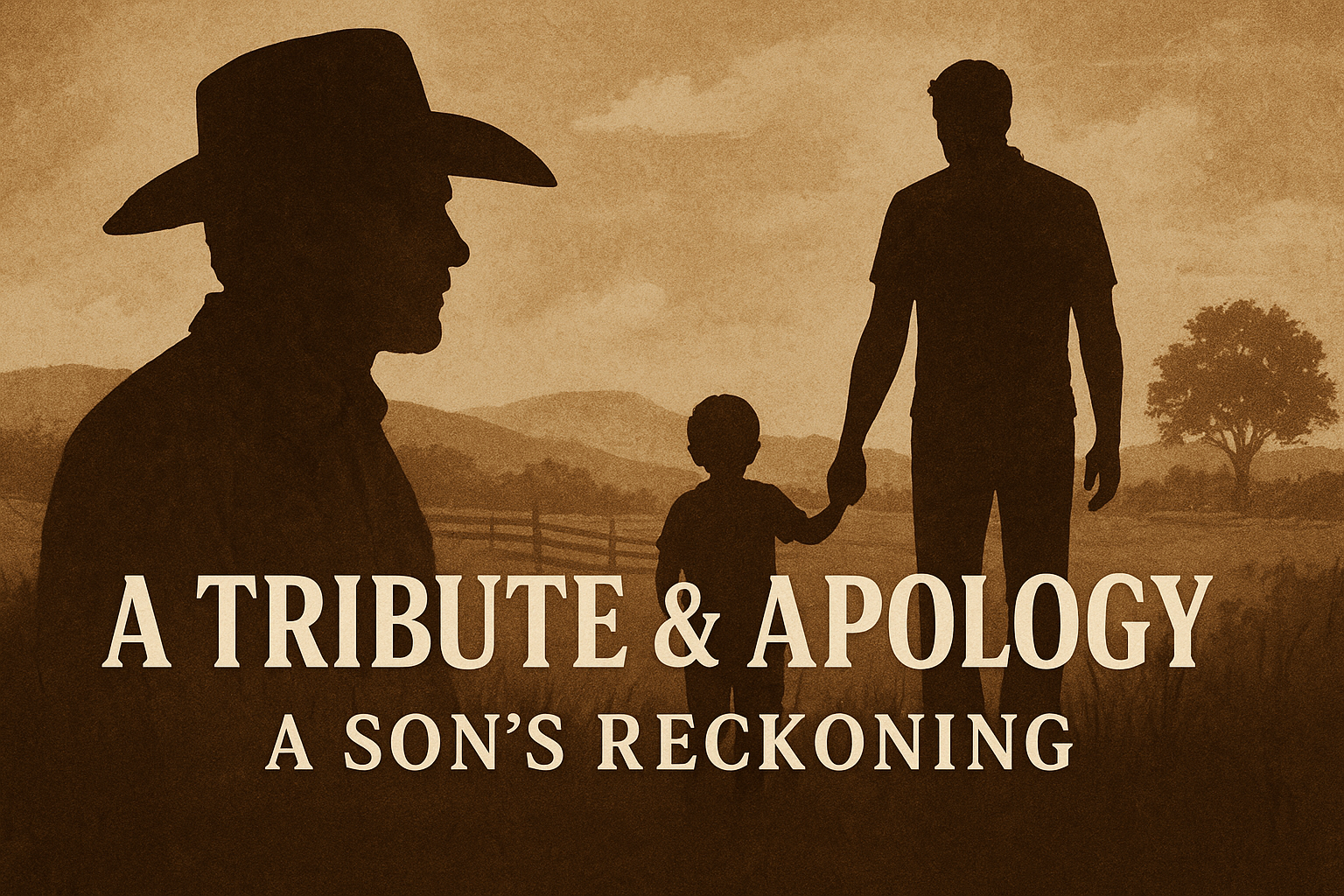
When Ryan “Dickie” Thompson titled his June 26, 2025 vlog “A Tribute and an Apology,” he signaled something raw, real, and deeply personal. In his conversation on Disruptarian Radio, hosted by Amy, he let listeners into the heart of a complex journey—a man shaped by his father’s legacy, scarred by family conflict, and determined to break the cycle of silence that so many men endure.

1. A Father of Integrity—Richard Glen Thompson
Ryan paints his father as a man of fierce purpose: a civic-minded rancher, construction business owner, and city‑planning advocate in Mapleton, Utah. He carried “a principle that his ideals weren’t just beliefs—they were calls to action.” When Mapleton’s sewage‑system crisis arose, his father proposed a major overhaul—sourcing pumps from Geneva Steel, drafting plans—only to see the vision sidelined at the time. Years later the city is still exporting their waste to Spanish Fork to be processed at premium rates.
Where if the city collected and then processed the waste to be treated locally, the cost of this process would save the city 10-20% per year. Which if combined as a whole, would have ben savings to the city and to tax payers millions and millions of dollars. Since the 1990s.
But then politics, and gentrification systems installed there, will push out ways to make it more affordable to live there. Growth is not a primary issue for these cities, and by design.
So I see the metric. But still what my father was proposing was a sound and easily executed solution to localized infrastructure, and still could be sold at a premium rate, and people are still happy to pay that fee, just to live there.
It's just an interesting milepoint that I compare now looking back, first hand, how certain forks in the road, my both feel like a bad but necessary choice to make. One way would have worked in it's own way. The other also able to nearly autonomously be able to function perfectly and more productively in its own way.
At home, Richard was the proud patriarch of nine children and eighteen grandchildren. Ryan remembers him introducing himself with beaming pride: “I have nine children.” He speaks warmly of growing up on a ranch in Arizona: learning responsibility and resilience, confronting loss—like a tough year when calves died while Dad was away—and realizing that nothing worth building comes easy.
2. The Cowboy Code: Grit, Honor, and Empathy
To Ryan, his father was a real‑life cowboy: gritty, honest, and anchored in a code of honor. That cowboy spirit permeated his work—whether repairing machinery, building homes, or tending animals. Ryan says that Dad “demanded both excellence and honesty” and taught lessons through both tenderness and tough love. Even when he didn’t always see eye‑to‑eye, Ryan recognizes those moments now as foundational to his own character.

3. Childhood Conflicted: Anger, Absence, and Misdirection
But not all was idyllic. Ryan admits he grew up angry. His father worked sixteen‑ to eighteen‑hour days; he missed him and misunderstood his absence as rejection. Even more painful was the home conflict: emotional manipulation, false accusations—enough to bring charges against his father after a confrontational incident involving a chair. Ryan says, “I watched the truth get twisted until reality became… unrecognizable.” It taught him the hard way that if you have no documentation or defense, lies can feel like reality.
He even credits this trauma with shaping his later life: launching a security business and documenting everything, so he—and any other man—couldn't be taken by surprise or silenced by falsehood. Leading to two projects www.veracitylife.com (completed), and presently www.veracityintegrity.com (active as of 2025)
4. Rebuilding Fatherhood: Marriage, Workaholism, and Tragedy
Determined to rewrite that narrative, Ryan built businesses so his wife could homeschool and pursue her passions. He worked one hundred‑hour weeks, eliminating bars, distractions, friends—only work and family. But it almost killed him. Burned out, fatigued, he drove straight from Northern California to Seattle, worked nonstop, then was hit head‑on by a drunk driver who died instantly.


Before the accident (volunteering to complete the Tough Mudder)
Hours before the accident (talking about my long long work days, with sometimes no sleep for a week)
After the accident (why I blog) while in the hospital
In a wheelchair and humiliated by the ordeal, he faced the unfiltered consequences of modern parenthood—mockery and accusations—not for abuse, but for being emotionally checked out and dependent on pornography during lonely stretches. His wife exposed him in front of her parents and his kids over something he had tried to be honest about. He found himself vilified—“the villain”—despite having sacrificed everything he had for his family.
5. The Silent Crisis: Men’s Pain and Social Pressure
Ryan sees his story as part of a broader epidemic. “Men… silently suffering” endure the most dangerous jobs, die younger, lose custody more often, and still are told to “man up.” The stigma around vulnerability kills—literally. He points to men’s high suicide rates and insists our silence is deadly. “We need to create a space where men can speak their truth without fear of further condemnation.”
He acknowledges that women face burdens too, but stresses that men’s burdens are unique, deserving acknowledgment. It’s not a competition—it’s a call for honesty, empathy, and space for men to feel deeply without shame.
6. Reconnecting: To Children, Family, and Hope
To his kids, Ryan says, “I never stopped loving you.” He didn’t leave because he gave up—he fled to survive. He’s reconnecting with their sister abroad, careful, honest. His hope: that his children will feel safe enough to reach out, to meet with forgiveness, understanding, and opened arms.
And he issues a broader invitation: share this story not for him, but for the next man carrying his own private burden. To offer solace where isolation threatens.

7. Lessons for Disruptarian Readers
Ryan’s experience speaks powerfully to libertarian and free‑market values:
- Individual Responsibility & Accountability. He took agency—starting businesses, documenting truth, building bridges—rather than leaning on government or victimhood.
Ryan's autobiography from when he was 20 is here: mystory.behindzioncurtain.com (archive) - Stoic Resilience. Echoing his father’s integrity, he endured loss, injustice, injury, and betrayal while refusing to be defined by bitterness.
- Voluntary Connection & Healing. Without mandates, he’s actively rebuilding broken relationships through honesty, humility, and open invitation.
- Breaking Silence to Save Lives. Emotional freedom isn’t just philosophical—it’s life‑saving. By speaking openly about pain, he champions the ultimate voluntary exchange: vulnerability for hope.

