

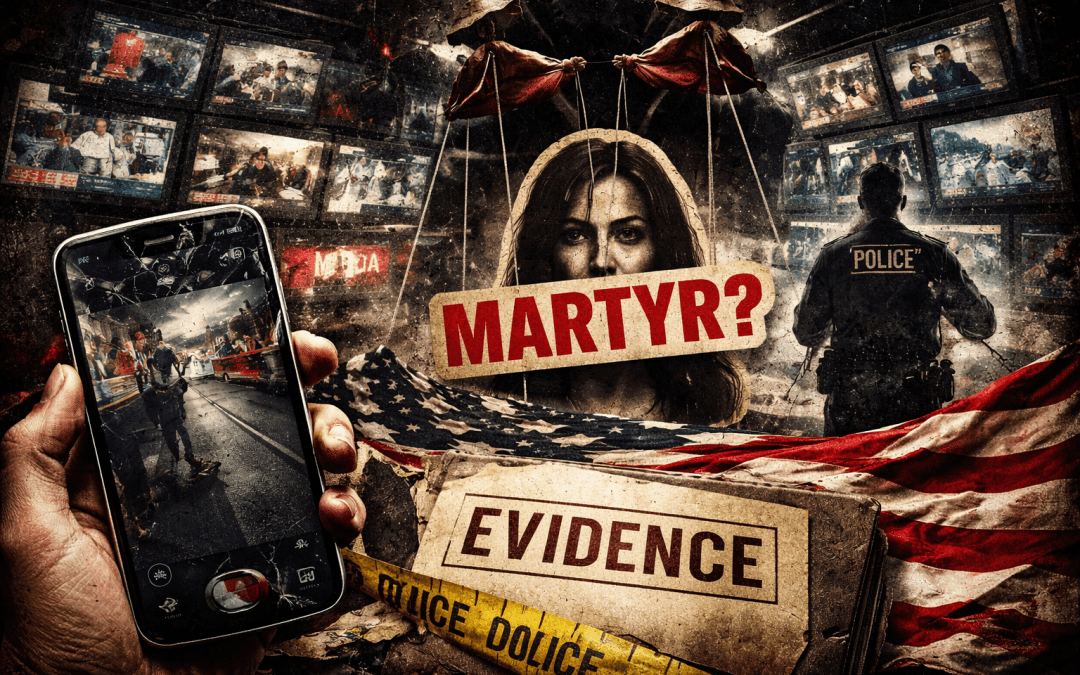
“`html
Fake Hate Crimes: 7 Brutal Lessons From Renee Good and George Floyd
I’m Ryan “Dickie” Thompson, and I’ve got a problem. I don’t trust emotional stampedes.
Not the left’s stampedes. Not the right’s stampedes. Not the “BREAKING NEWS” stampedes that magically appear whenever a bureaucracy needs cover, or a movement needs a fresh martyr.
That’s why I keep circling back to fake hate crimes. Not because every hate crime is fake (they aren’t), but because the modern outrage machine runs on the same fuel: story first, evidence later, and shame for anyone who asks questions.
Matt Walsh’s rant on Renee Good and the George Floyd fallout hits the nerve: when the video shows up, a lot of sanctimonious narratives die on the spot.
[Image: A gritty collage of cable news chyrons, protest signs, and blurred video stills | ALT: fake hate crimes thrive on headlines before evidence]
Table of Contents
- What happened with Renee Good, according to the actual reporting
- The “information vacuum” trick and why it looks like fake hate crimes
- Matt Walsh’s blunt point on Renee Good: cars are not protest signs
- George Floyd: the part everyone lies about, on purpose
- Why “new George Floyd” moments are harder to manufacture now
- Fake hate crimes: the outrage product that never goes out of stock
- What Renee Good’s case teaches without calling it a hoax
- A rule that will save your brain in 2026
- The liberty angle: I don’t trust mobs or bureaucracies
- 7 brutal lessons that keep showing up
- Links worth reading if you don’t want to be a mark
- Sources
What happened with Renee Good, according to the actual reporting
Let’s start with the boring part, the part that ruins everyone’s fan fiction.
Renee Nicole Good, 37, was shot and killed in Minneapolis during a federal immigration enforcement operation. Federal officials defended the shooting as self-defense. Minnesota officials pushed back. The FBI got involved in the investigation. That’s the baseline.
AP described a bystander video released by DHS showing Good’s SUV partially blocking the road, honking, agents approaching, and her wife yelling, “drive, baby, drive.” The video shows an agent moving in front of the vehicle as it drives forward and shots are fired.
You can argue intent all day. But you don’t get to argue physics.
A moving vehicle, an officer in front of it, a tense arrest scene. That’s a lethal-force scenario in basically every adult brain on earth.
The “information vacuum” trick and why it looks like fake hate crimes
Here’s how fake hate crimes and viral outrage incidents stay alive.
Step one: keep the story vague.
Step two: demand moral certainty anyway.
Step three: punish anyone who asks for details.
Step four: release evidence later, after the public already picked a religion.
That vacuum is the oxygen.
And no, this isn’t spooky. It’s incentives. The first wave of a hate narrative brings attention, influence, and power. Corrections show up later, when nobody’s watching, and the people who got famous off the lie never pay the bill.
That’s why fake hate crimes are more than lies. They’re social weapons. They’re leverage.

fake hate crimes and viral outrage depend on selective footage
Matt Walsh’s blunt point on Renee Good: cars are not protest signs
If you want to protest ICE, go protest ICE.
Hold signs. March. Sue. Petition. Vote. Run for office. Do the tedious citizenship stuff that actually matters.
But if you use a vehicle to obstruct, surround, or box in agents during an arrest scene, you are inviting escalation. That’s not me worshiping the state. That’s me acknowledging reality. Cars turn into weapons real fast, especially when you’re using them as a movable barricade.
And this matters beyond this case. Prosecutors have used “false imprisonment” logic against bridge blockers for trapping drivers by blocking major roads. In plain English, if you trap people with your little road blockade stunt, the law can treat it as more than a traffic ticket. Because it is.
Walsh goes harder than I do in tone, but the spine of the argument is obvious: if you move a vehicle into an officer, you don’t get to act shocked when force follows.

fake hate crimes and viral outrage depend on selective footage 2
George Floyd: the part everyone lies about, on purpose
Now the radioactive part.
Walsh argues the Floyd narrative was built on a single angle, with context delayed, and later footage complicated what people were sold. It’s true the full bodycam context entered public view later, not as an immediate “here’s everything” dump.
And yes, transcripts show Floyd saying he couldn’t breathe earlier in the encounter, before he was on the ground. That doesn’t “solve” the case, but it does smash the childish idea that reality fits in a slogan.
Medical reality is messy, and slogans hate messy
The official medical examiner ruling lists restraint and neck compression in the causal chain, and also lists fentanyl intoxication and methamphetamine use as significant conditions. That’s the real world. Not a chant.
Here’s my stance, and I know it irritates the faithful: the country was sold a simplified myth, and the truth is uglier and more complex than the myth.
That’s also why fake hate crimes work so well. Complexity is the enemy of outrage. Outrage wants a clean villain and a clean victim, right now, with no waiting.
Why “new George Floyd” moments are harder to manufacture now
Walsh says the country is different now. On some points, it is.
Information moves faster. People demand video faster. And a lot of Americans have learned, the hard way, that the first version of the story is often a sales pitch.
That doesn’t make people wise. It just makes the window smaller. When footage lands quickly, you can’t build a whole cathedral out of a headline without it snapping in public.
Fake hate crimes: the outrage product that never goes out of stock
Alright. Let’s talk straight about fake hate crimes.
They exist because the payoff is huge.
The first 24 hours of a hate narrative can get you national media attention, institutional apologies, fundraisers, firings, policy changes, and social status. Then the correction comes later, after the mob got its dopamine and wandered off.
Example: Jussie Smollett and the “instant myth” economy
The Smollett story detonated culturally, and then the legal story got messy. The media lesson stays simple: the accusation got the megaphone, and the follow-ups got the fine print.
Example: SUNY Albany and a fabricated “attack”
In 2016, students were charged after police said an alleged racially motivated attack was fabricated. Institutions rushed early. Reality showed up later. That’s the playbook.
Example: a reported subway hijab incident police said was invented
Reuters reported police said a woman fabricated an attack story. Again, the headline travels farther than the correction.
Example: a staged cross burning allegation
AP reported on a case where a man was accused of staging a cross burning on his own property. If you want to see how fast a staged incident can inflame a town, start there.

A notebook stamped HOAX beside a viral headline on a phone
What Renee Good’s case teaches without calling it a hoax
Renee Good’s death has become a political object.
One side wants a martyr. The other wants a cautionary tale. Everyone wants leverage.
That hunger is the same hunger that creates fake hate crimes, even when the event itself is not a staged hoax. The marketing and the moral blackmail follow the same script: “agree with us instantly, or you’re evil.”
My stance is simple: release everything fast. Let people see the timeline. Let independent reviewers analyze. Secrecy is where propaganda breeds, and propaganda is where fake hate crimes thrive.
A rule that will save your brain in 2026
Here’s my rule. It’s boring. It also works.
No footage, no outrage.
You can get my attention without evidence.
You can get my sympathy without evidence.
You do not get my certainty without evidence.
That rule protects you from fake hate crimes, selective editing, viral lies, “trust me bro” activism, and bureaucrats who hide behind vibes.
The liberty angle: I don’t trust mobs or bureaucracies
If you’ve read Disruptarian for five minutes, you know I don’t do blind loyalty.
I don’t trust a screaming crowd that wants blood. I also don’t trust agencies that slow-walk evidence until the public forgets what it was asking for.
The state has incentives. Activists have incentives. Media has incentives. So the only antidote is transparency: quick release of footage, clear timelines, independent review, FOIA that actually works, and consequences for lying on all sides.
That’s how you choke off fake hate crimes and choke off state spin at the same time.
7 brutal lessons that keep showing up
1) The first headline is usually a pitch, not a verdict
If you’re forming your worldview off the first chyron, you’re being used.
2) Fake hate crimes thrive in evidence droughts
No details, all outrage. That’s the sweet spot.
3) Video doesn’t end arguments, but it exposes lazy lies
People can still argue about what they saw. But it’s harder to invent a whole new reality.
4) Cars are weapons when you use them like weapons
You don’t get to “oops” your way through a confrontation with armed agents and pretend it’s just vibes.
5) Medical complexity gets flattened into slogans on purpose
The Floyd case is the clearest example. Reality got reduced to a chant.
6) Corrections never go as viral as accusations
That’s why fake hate crimes are profitable in attention terms.
7) If you want freedom, demand proof from everyone
That includes the state. That includes activists. That includes “your side.”
Links worth reading if you don’t want to be a mark
- DOJ Hate Crimes overview
- FBI Crime Data Explorer: Hate Crime data
- AP: Video sequence reporting on the Renee Good shooting
- Reuters fact check: “overdose was main cause” claim about George Floyd
- Matt Walsh episode link
Sources
- DOJ Hate Crimes | https://www.justice.gov/hatecrimes
- FBI Crime Data Explorer (Hate Crime data) | https://cde.ucr.cjis.gov/LATEST/webapp/#/pages/home
- AP: Video sequence reporting on Renee Good shooting | https://apnews.com/article/3f2a9e26ddac9455b931fecee5989d18
- Reuters: Fact check on “overdose main cause” claim about George Floyd | https://www.reuters.com/article/fact-check/no-evidence-drug-overdose-was-main-cause-of-death-for-george-floyd-in-2020-idUSL1N3241XJ/
- Hennepin County Medical Examiner press release (Floyd) | https://content.govdelivery.com/attachments/MNHENNE/2020/06/01/file_attachments/1464238/2020-3700%20Floyd%2C%20George%20Perry%20Update%206.1.2020.pdf
- Matt Walsh episode | https://www.youtube.com/watch?v=VjHAuISIdsk
“`

Spun Web Technology SMART SEO