
Bill Maher, Ice Cube, and the Prison Industrial Complex: Follow the Money
By Ryan “Dickie” Thompson
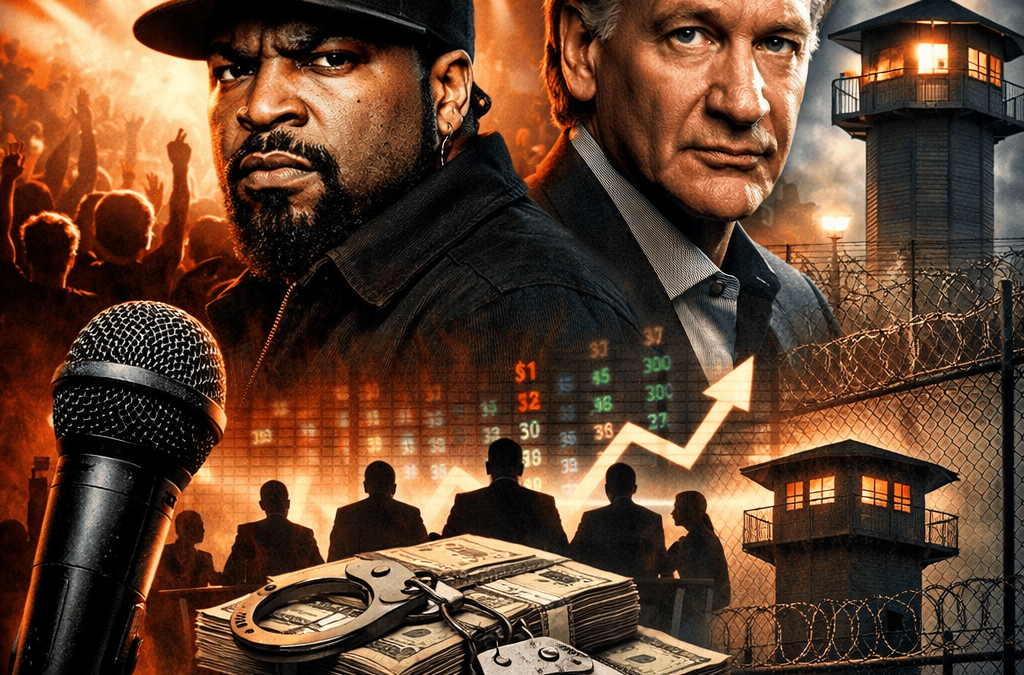
When Ice Cube sat down with Bill Maher and said, “follow the money,” he wasn’t joking. He was pointing to something deeper than rap lyrics. He was talking about power. He was talking about influence. And he was talking about who benefits from chaos in American culture.
In the clip, Ice Cube makes a bold claim. He says that some of the same financial interests behind major record labels also have investments in private prisons. Not necessarily the same executives clocking in at both offices, but overlapping financial ownership at the top. Institutional investors. Corporate shareholders. Wall Street money.
Bill Maher pushes back. He asks the obvious question. Is there proof that record executives are actively pushing lyrics that funnel young men into prison? Or is it just capitalism doing what capitalism does?
This is where it gets interesting.
The Prison Industrial Complex and Private Prisons


The prison industrial complex is not a conspiracy theory. It is a term used to describe the relationship between government and private industry that profits from incarceration. Companies like CoreCivic and GEO Group run private prisons under government contracts. The more inmates they house, the more revenue they generate.
That alone should concern anyone who believes in limited government.
When incarceration becomes a profit center, incentives shift. Instead of justice, you get quotas. Instead of rehabilitation, you get long sentences. Instead of accountability, you get lobbying.
Libertarians have been warning about this for decades. Government should not partner with corporations to cage human beings for profit. That is crony capitalism at its worst.
Bill Maher even agrees on that point. He says prisons should not be in private hands. He compares it to healthcare. Some things should not be run for profit.
From a free market perspective, the deeper issue is not profit. It is government power. Private prisons only exist because government writes the laws, enforces the drug war, and fills the cells.
Record Labels and Social Engineering



Ice Cube says something that hits hard. He talks about “guard rails.” He says record companies do not force artists to write certain lyrics. Instead, they shape what gets promoted. What becomes a single. What gets radio play. What gets pushed to the top of the charts.
That is not crazy talk. That is how the music industry works.
Singles are chosen by committee. Marketing budgets are allocated strategically. Radio and streaming playlists are curated. If you want to influence culture, you do not have to control every word. You just amplify certain messages.
Ice Cube suggests that violent, criminal, and anti-police themes often get promoted more than positive or conscious rap. If that is true, the question becomes: why?
Is it because controversy sells? Or because chaos benefits certain systems?
The free market answer is simple. Sex, violence, and rebellion sell. Labels chase profit. That is capitalism.
But there is another layer. What if the same institutional investors who profit from incarceration also profit from entertainment? What if Wall Street money flows into both sectors?
Now it is not about executives plotting in a smoke-filled room. It is about financial incentives at scale.
Publicly traded companies answer to shareholders. Shareholders want returns. If prison stocks rise when incarceration rises, and music stocks rise when certain content trends, the market starts to align in uncomfortable ways.
This is not central planning. It is decentralized incentive structure. And sometimes that is just as powerful.
Follow the Money: Ownership and Influence
When Ice Cube says “the same people,” he is likely talking about institutional ownership. Firms like Vanguard, BlackRock, and State Street often hold shares across multiple industries. Media. Prisons. Healthcare. Defense.
They do not micromanage lyrics. But they influence corporate governance. They influence board decisions. They influence long term strategy.
This is what happens when financial power consolidates at the top.
From a libertarian view, the problem is not that investors seek profit. The problem is when government policy creates artificial profit streams. The war on drugs, mandatory minimums, and overcriminalization created a pipeline into prisons.
If music amplifies a culture that feeds that pipeline, even indirectly, it deserves scrutiny.
But we should be careful.
The state is still the primary driver. Without federal drug laws, aggressive policing, and bloated criminal codes, there would be far fewer inmates to begin with.
Blaming music alone misses the real issue.
Independent Artists vs Major Labels
Ice Cube makes another key point. He stayed independent. He did not allow record executives in his studio. He controlled his art. That is free market entrepreneurship in action.
Independent labels like Priority gave him more freedom. Major labels often operate differently. They have larger budgets and larger expectations. With that comes control.
This is not unique to rap. It happens in pop, country, and rock. The more money involved, the more stakeholders demand influence.
Bill Maher argues that artists who make money get more freedom. There is truth there. Power in business comes from leverage. If you generate revenue, you can negotiate.
But for new artists chasing a contract, the power imbalance is real.
This is where free markets shine. Technology has broken down many of these barriers. Artists can now distribute music directly through platforms like YouTube, Spotify, and TikTok. Gatekeepers are weaker than they were in the 1990s.
Decentralization is happening.
Division, Bickering, and Cultural Control
Ice Cube’s broader point is not just about rap lyrics. It is about division. He asks who benefits from Americans fighting each other over race, politics, and culture.
Division keeps people distracted. While we argue on social media, lobbyists write legislation. While we fight over lyrics, Congress expands surveillance.
The real danger is centralized authority.
When government and big business become intertwined, you get a system that feeds on conflict. The prison industrial complex grows. Media narratives polarize. Politicians gain power by promising to fix problems they helped create.
Libertarians call this the state corporate alliance. It is not a free market. It is crony capitalism.
The Real Solution: Shrink the State
If we are serious about reform, we need to focus on policy.
End the war on drugs. Reduce mandatory minimum sentences. Eliminate private prison contracts tied to occupancy guarantees. Audit government incentives that reward mass incarceration.
At the same time, support independent creators. Break up regulatory barriers that protect major labels. Encourage competition in media and entertainment.
Freedom works when government steps back.
Ice Cube may frame it as social engineering. Bill Maher may see it as capitalism. The truth is somewhere in between. Cultural influence is real. Financial incentives are real. But the biggest driver of incarceration is still government policy.
If we want fewer prisons, we need fewer laws.
Follow the money. Yes.
But also follow the power.
And power in America still flows through Washington.
-
Club Random with Bill Maher featuring Ice Cube transcript | https://www.youtube.com/watch?v=Ec6jeORp3GA
-
Private Prison Industry Overview | https://www.sentencingproject.org
-
CoreCivic Company Information | https://www.corecivic.com
-
GEO Group Corporate Overview | https://www.geogroup.com
-
Bureau of Justice Statistics Prison Data | https://bjs.ojp.gov

Spun Web Technology SMART SEO