


I’m not writing this as an academic. I’m writing it as a guy who got tired of being told what to think, by people who were very sure they should be in charge.
The Ethiopian Bible hit me like that. Not because it’s “exotic,” and not because I’m chasing some mystical flex. It hit me because it exposes a simple fact most Western Christians were trained to ignore: the Bible you grew up calling “the Bible” is a historical product. It got shaped, trimmed, organized, and standardized. That process was not always evil, but it was always political.
Rastafari gave me language for the political side of religion. Ethiopia gave me receipts.
Table of Contents
-
The Ethiopian Bible and the “closed box” lie
-
Ethiopian Bible quick map: what the 81 books do to your worldview
-
Canon is politics, and Babylon loves canon fights
-
Ethiopia is ancient Christianity, not a side quest
-
Geʽez manuscripts and the Garima Gospels
-
The Book of Enoch, Jude, and a rebellious Ethiopian Bible
-
A “cosmic Christ” that institutions can’t domesticate
-
Rastafari livity and the refusal to outsource conscience
-
Leaving Mormonism taught me to test priesthood claims
-
The Lemba tribe, DNA, and what science can and can’t prove
-
Tabot, Ark talk, and temple logic still alive
-
Jamaica, Abuna Yesehaq, and the bridge between Ethiopia and Rasta
-
How to read the Ethiopian Bible without turning it into cosplay

Geʽez manuscript on parchment
1) The Ethiopian Bible and the “closed box” lie
Most people I know were raised to treat scripture like a sealed container. Sixty six books, leather cover, ribbon marker, case closed. If you question the box, you’re “questioning God.”
Nah. You’re questioning a publishing tradition.
The Ethiopian Bible forces an honest question: when somebody says “the Bible,” which community’s Bible do they mean?
And that question matters, because power loves “closed boxes.” If the box is sealed, the gatekeepers get to stand in front of it and charge you admission.
2) Ethiopian Bible quick map: what the 81 books do to your worldview
People hear “81 books” and immediately ask, “So what, it’s just extra content?”
That question is the Western consumer brain talking. The Ethiopian Bible isn’t DLC. It’s inheritance.
A wider Ethiopian Bible canon gives you a different spiritual vocabulary. You see more apocalyptic critique. You get more “princes of power” language. You get more warnings about corrupt rulers and crooked priests. You get more cosmic imagination, which is exactly what Babylon tries to flatten into dull compliance.
It also changes how you read the New Testament. When the Ethiopian Bible keeps books like Enoch and Jubilees in the neighborhood, you start noticing how many New Testament ideas sound like they grew out of a bigger Second Temple world than your Sunday school ever admitted.
And yes, for the record: the Ethiopian Bible absolutely includes Jesus. The debate is not “Is Ethiopia Christian?” The debate is why so many Western folks act like Christianity needs a European passport to be considered real.
If you feel defensive reading that, I get it. I used to feel it too. Then I started asking myself who trained me to feel that way.
3) Canon is politics, and Babylon loves canon fights
I’m not here to start a holy war over who has the “real Bible.” I’m here to point out something simpler: canon decisions are always tied to authority.
If a centralized institution can define the library, it can define the boundaries of “acceptable” spirituality. That’s not automatically sinister, but it is a power move. And Babylon loves power moves.
Babylon, in Rasta language, is the whole system that trains you to obey first and think later. It’s the state, the corporate church, the credential cartel, the propaganda machine. It’s any structure that punishes conscience.
A bigger Ethiopian Bible does something dangerous in a Babylon world. It widens the conversation. It adds prophetic heat. It forces you to admit there were other streams of early Jewish and Christian thought that didn’t survive as the mainstream Western default.
Also, it humbles you. Because if God spoke to more than one tradition, then nobody gets to play landlord over the Spirit, not Rome, not Canterbury, not Salt Lake, not your favorite streaming preacher.
4) Ethiopia is ancient Christianity, not a side quest
People talk like Ethiopia “adopted” Christianity late, like it’s a branch office of Rome. That’s historically sloppy.
Ethiopia is ancient Christianity, with its own deep story, its own fasting discipline, its own liturgy, its own saints, and its own continuity. It didn’t need Western permission slips.
If you grew up in a modern megachurch, or in a tight controlled denomination, it can be hard to grasp this: the Christian world was never one centralized thing. It was a messy, spread out, multilingual movement. Ethiopia is not “extra,” it’s foundational.
And that’s part of why the Ethiopian Bible matters. The Ethiopian Bible is attached to a living church that carried texts, liturgy, and theological memory through centuries when other regions were busy fighting over who gets to be boss.
5) Geʽez manuscripts and the Garima Gospels
A lot of Western Christians think “ancient manuscripts” means Egypt, Greece, Rome. Ethiopia belongs in that sentence too.
Geʽez became Ethiopia’s classical liturgical language, and Ethiopia built a serious manuscript tradition around it. That matters, because manuscripts are receipts. They prove who was in the room early, who preserved what, and who didn’t.
One of the most famous examples is the Garima Gospels. The point isn’t “my manuscripts are older than yours.” The point is that Ethiopia was never a footnote.
So when somebody shrugs and says the Ethiopian Bible is “weird,” I hear the subtext: “If it didn’t come through Western channels, it doesn’t count.”
That’s Babylon talk. Hard pass.
6) The Book of Enoch, Jude, and a rebellious Ethiopian Bible
Now we get to the fun part.
The Ethiopian Bible preserves 1 Enoch in full. And even if you don’t treat it as canon, you should recognize its influence.
Jude uses language that lines up with Enoch in a way scholars have argued about for a long time. So this is not random fan fiction. This is part of the Second Temple Jewish world that early Christians swam in.
Enoch reads like moral protest. It confronts corrupt powers, cosmic rebellion, defilement of the earth, and the idea that God sees what the rulers hide. If you’ve ever looked around and thought, “The system is lying,” you will understand why Enoch lands hard.
And yes, it also explains why institutions get nervous around apocalyptic texts. They don’t want average people hearing “judgment against corrupt rulers” and then looking up from the pew like, “Wait, you mean them too?”
7) A “cosmic Christ” that institutions can’t domesticate
One of the biggest lies in Western religion is the soft domesticated Jesus. The safe one. The one who never flips tables. The one who never threatens an empire. The one who exists mostly to keep you polite.
The Ethiopian Bible tradition keeps a very different vibe alive: Christ as overwhelming. Radiant. Too big to be packaged.
Now, I’m careful here. Some modern narrations get dramatic and slide into claims that go beyond what we can verify. I’m not doing that. I’m talking about the overall spiritual posture: majesty, holy fear, transformation, and union with God instead of a cheap “say the words, join the club” transaction.
A Christ who is only “nice” is easy for Babylon to sponsor.
A Christ who is sovereign and judging is hard to weaponize for empire. Harder to turn into a mascot for tax collectors and censors.
This is where the Ethiopian Bible shakes people. The Ethiopian Bible reminds you that the gospel is not a therapy brand. It’s a claim about reality and authority.
8) Rastafari livity and the refusal to outsource conscience
I’ve said it before and I’ll say it again: Rastafari is not “weed and reggae.” It’s livity. It’s discipline. It’s an anti-Babylon stance lived out in daily choices.
Rasta is also decentralized. No pope. No single council. That makes some people nervous. It makes me breathe easier.
Because I’ve watched what centralized religious power does. It starts by telling you what to believe, and ends by telling you what you’re allowed to say. It’s the same control impulse in church clothes.
Rasta forces reasoning. You have to test spirits. You have to live what you say. You can’t hide behind “my pastor said” when your life is a mess.
If you want my personal story version, that old “What Rasta Means to Me” video is still up. I was rougher around the edges then, but the core is the same.
9) Leaving Mormonism taught me to test priesthood claims
I was raised Mormon. Utah culture. The whole thing. I also know what it’s like to invest your whole identity in a story, then realize parts of that story don’t survive contact with evidence.
That experience trained me to do something most institutions hate: ask for receipts.
I’m not here to dunk on individuals. I’ve got friends and family in that world. But institutions that demand loyalty while discouraging investigation are a problem. Always.
And this is where the Ethiopian Bible theme matters again. Once you see that the Ethiopian Bible story is bigger than one American restoration narrative, you stop letting gatekeepers threaten you with shame.
You start reading wider, listening wider, and refusing to call comfort “truth.”
10) The Lemba tribe, DNA, and what science can and can’t prove
The Lemba story grabbed me because it sits at the intersection of oral tradition, migration, identity, and modern genetics.
The basics: the Lemba are a southern African group with long held traditions of Middle Eastern or Jewish ancestry. Researchers tested those traditions using Y chromosome markers.
Here’s my libertarian takeaway: DNA is a tool, not a priest. It can suggest population history. It cannot deliver a divine stamp of identity.
Still, the Lemba tradition matters because it refuses the colonial script that says Africa is always a late arrival to sacred history, including the sacred history behind the Ethiopian Bible world.
Also, it’s a warning against fake certainty. The Mormon world taught me that “certainty” can be manufactured. Science taught me that humility is part of truth.
If you want more of my newer writing on priesthood, land, lineage, and the DNA debate, I’ve got a piece on Disruptarian that digs into those tensions:
/blog/israel-place-people-priesthood-and-the-dna-debate-nobody-wants-to-finish/
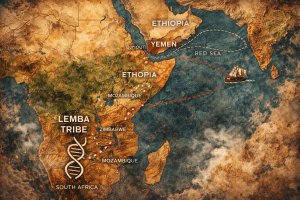
Lemba map Southern Africa
11) Tabot, Ark talk, and temple logic still alive
Western Christianity often treats the Old Testament like an opening act. Read it, quote it, then move on to “real” religion.
Ethiopian Orthodoxy never fully did that.
The tabot tradition keeps temple logic alive: sacred space, embodied worship, procession as theology, not performance. Whether you agree with every detail or not, you can still recognize what it preserves.
And there’s a modern political edge here too. Colonial extraction didn’t only steal gold and land. It stole sacred objects, then pretended that was “education.”
That’s Babylon. Every time.
12) Jamaica, Abuna Yesehaq, and the bridge between Ethiopia and Rasta
A lot of people assume Rastafari is anti-Christian by default. It’s more accurate to say it’s anti-colonial Christianity.
There is a real historical bridge between Rasta communities and the Ethiopian Orthodox Church in Jamaica, and that matters because it shows Rasta people weren’t rejecting Christ. They were rejecting Babylon’s version of Christ.
And yes, I know: there are multiple “mansions” in Rasta, and not everybody agrees on Haile Selassie’s divinity. That diversity is real. But the shared refusal is also real: we’re not handing our conscience to empire.
If you want more of the cultural context, I also wrote about reggae as spiritual struggle and resistance:
/blog/reggae-is-the-music-of-spiritual-struggle-la-croix-international/
Video: Revealing the mysteries of a Lost Tribe, the Lemba and Rastafari | Note: This video connects the Lemba story to priesthood questions and Rasta identity.
13) How to read the Ethiopian Bible without turning it into cosplay
This section is for my people who get excited, then get weird.
The Ethiopian Bible is not a costume. It’s not a vibe. It’s not a reason to play pretend priest on the internet. It’s a living canon in a living church.
So here’s my simple rule set for approaching the Ethiopian Bible like an adult:
-
Start with humility. You are a guest in somebody else’s house. Don’t act entitled.
-
Separate “canon facts” from “internet myths.” Use the church’s canon list as your baseline, not TikTok lore.
-
Read in layers. The Ethiopian Bible doesn’t replace the New Testament, it frames it in a wider library.
-
Don’t confuse symbols with lab proof. The Lemba story is meaningful, but DNA does not certify holiness.
-
Keep your anti-Babylon filter on. If somebody is selling you “secret knowledge” for clicks, that’s Babylon too.
If you want a practical starting point, do this: read the Gospels, then read Jude, then read 1 Enoch, and pay attention to the moral target. Who is being judged? What kind of power gets condemned? What kind of holiness is demanded?
That’s when the Ethiopian Bible starts making sense. The Ethiopian Bible is not asking you to win arguments. The Ethiopian Bible is asking you to stop serving corrupt systems with your silence.
Where I land, still
I’m not asking you to join a church. I’m not selling a label. I’m telling you what I had to learn the hard way.
The Ethiopian Bible reminds me that scripture and tradition were never owned by the West.
Rastafari reminds me that faith without liberation is usually somebody else’s religion.
The Lemba story reminds me that identity is bigger than the categories colonial history tried to impose.
And Babylon, whether it wears a government badge or a church collar, still hates the same thing: free minds.
So if you read this and feel that itch, that holy discomfort, good. That’s your conscience waking up.
Seek the Most High. Read wider. Test the spirits. Treat institutions like what they are: human tools that can help, but also can rot.
Choose Zion over Babylon. Even when it costs you something.
Sources
-
Reverend Ryan – What Rasta Means to Me (YouTube) https://www.youtube.com/watch?v=E04JxgW8jOI
-
Revealing the mysteries of a Lost Tribe, the Lemba and Rastafari (YouTube) https://www.youtube.com/watch?v=EZXiJfmjIPc
-
The canon of the Ethiopic Bible (Ethiopian Orthodox Church) https://www.ethiopianorthodox.org/english/canonical/books.html
-
Rastafari | History, Beliefs, & Facts (Britannica) https://www.britannica.com/topic/Rastafari
-
Ethiopian Orthodox Tewahedo Church | History, Beliefs & Facts (Britannica) https://www.britannica.com/topic/Ethiopian-Orthodox-Tewahedo-Church
-
Revised dating places Garima Gospels before 650 (Kenyon College, PERE Journal PDF) https://digital.kenyon.edu/cgi/viewcontent.cgi?article=1209&context=perejournal
-
The Cohen Modal Haplotype and the Origins of the Lemba (PMC) https://pmc.ncbi.nlm.nih.gov/articles/PMC1288118/
-
NOVA Online | Lost Tribes of Israel | The Lemba (PBS |https://www.pbs.org/wgbh/nova/israel/familylemba.html
-
About (Ethiopian Orthodox Tewahedo Church in Jamaica) https://www.eotcja.org/about
-
Liturgical Worship: Unique Features of Ethiopian Orthodox Tewahedo Church (Tabot) https://eotcmk.org/e/unique-features-of-ethiopian-orthodox-tewahedo-church/
-
The Christological Use of I Enoch i.9 in Jude 14, 15 (Cambridge) https://www.cambridge.org/core/journals/new-testament-studies/article/christological-use-of-i-enoch-i9-in-jude-14-15/8DCDFDEC8A0991A3A6914DB795924104
-
Westminster Abbey agrees ‘in principle’ to return sacred tablet to Ethiopia (The Guardian) https://www.theguardian.com/world/2024/feb/19/westminster-abbey-agrees-in-principle-to-return-sacred-tablet-to-ethiopia
-
Westminster Abbey decides ‘in principle’ to return Ethiopian tabot (The Art Newspaper) https://www.theartnewspaper.com/2024/02/13/westminster-abbey-decides-in-principle-to-return-ethiopian-tabot
-
Israel: Place, People, Priesthood, and the DNA Debate Nobody Wants to Finish (Disruptarian) /blog/israel-place-people-priesthood-and-the-dna-debate-nobody-wants-to-finish/
-
Reggae: The Soundtrack of Spiritual Struggle and Resistance (Disruptarian) /blog/reggae-is-the-music-of-spiritual-struggle-la-croix-international/
-
Ethiopic canon list Ethiopian Orthodox Tewahedo Church
-
Rastafari overview Encyclopedia Britannica
-
Lemba genetics summary PBS
-
Lemba genetics paper PMC+1
-
EOTC Jamaica founding date Ethiopian Orthodox Church Jamaica
-
Garima Gospels dating Digital Kenyon
-
Tabot explanation EOTCMK
-
Tabot return reporting The Guardian+1
-
Jude and Enoch scholarship Cambridge University Press & Assessment
-

Spun Web Technology SMART SEO