
By Ryan “Dickie” Thompson, Disruptarian Radio
I just listened to the Tim Pool + Steven Crowder podcast (link below). It reads less like casual commentary and more like a war room debrief. Threats, death lists, swattings, home address leaks, calls for violence—all admitted on tape. That kind of raw exposure demands respect, not dismissal. But it also demands careful thinking. Because if you cross the line from warning into escalation, you lose your own ground.
Podcast link:
https://www.youtube.com/watch?v=N7M5KFpG17g
Below: my reaction, my red lines, and why I believe grassroots defenders like the Proud Boys still matter—if they behave in principle, not chaos.
Threats are real * don’t pretend they aren’t
The transcript you supplied has lines that make your spine tighten. Crowder talks about a “terrorist from Yemen by way of Sweden posting addresses.” Pool describes how the left deletes mocking memes about assassinations. They talk about lists of names, crosshairs, and threats that are “borderline overt.” This is not fiction. It is lived reality for many right-leaning creators.
If you are threatened, act as though the threat is real. Document the threat. Push it to law enforcement. Share it publicly in a controlled way. Fallacy: the idea that “if you complain, people will think you’re weak.” That is the enemy’s whisper. Use evidence, force accountability, but never let your own speech become a firehose of retaliation.
Rhetoric is powerful — use it wisely
Crowder, at times, challenges the idea that conservatives should be meek. He says, “Lawful violence in response is acceptable.” Fine. That is defensible. But language is slippery. Many listeners hear “lawful defensive violence” as “go get them.” The better path is to speak like a lion who restrains his claws until necessary, not a wildcard pistol that draws attention before the argument starts.
If your public posture becomes one of escalation, you’re playing into the opposition’s framing. They will point to any misstep to discredit the broader movement. If you’re going to argue self-defense, do it with restraint, clarity, and accountability. Let the burden of proof lie on the first aggressor.
Why the Proud Boys and grassroots defenders still matter
I have written about the Proud Boys before. Disruptarian coverage includes “Hawaiian Shirts, Order from Chaos, and the Counter-Narrative of the Boogaloo and Proud Boys” where I traced how these groups emerged when institutions failed. disruptarian.com
In that article I said this: when police, universities, and local governments surrender to crowd rule, the void is always filled by someone willing to enforce order. I observed that the Proud Boys and Boogaloo groups did not start as arbiters of ideological purity. They rose from discontent, disruption, and reaction. Sometimes those impulses align with liberty. Other times they don’t. But dismissing them entirely is naive.
I also interviewed a Proud Boys-adjacent figure, Nick Ochs, in “Interview with Nick Ochs on the Boogaloo”, in which we discussed doxxing and how even some okay people got drifted into labels. disruptarian.com Ochs had a black wife and child, yet identifies as Proud. That fact alone pokes holes in the idea that these are purely white supremacist outfits.
So yes, when masked mobs try to shut down Jewish speakers like Ben Shapiro or feminist voices like Christina Hoff Sommers, and decent people show up to push them back — I do not apologize. I never have. I believe in a culture where ideas compete, not fists.
But strength without discipline is chaos. Muscle without moral constraint becomes the same monster you claim to fight. If a Proud Boys contingent shows up to protect a speaker, they should: be strictly event security, follow a chain of command, respect local law, not escalate unless absolutely necessary, and clean up afterward. That kind of disciplined protecting of speech is service, not spectacle.
If a defender group wants my support, it must:
- Be non-race based
- Be ideologically flexible (liberty over dogma)
- Reject provocations they don’t control
- Train in de-escalation first, force only when unavoidable
- Never turn defense into political theater
That is the kind of muscle I want guarding free speech, not crowds.
How this ties into my 2019 & 2025 data
Let me put it in blunt terms: The podcast may spotlight threats, but the bigger story is the constants behind mass violence. From all my work (2019 and 2025 updates), the recurring patterns are:
- Men commit nearly all mass shootings
- Race tracks population: in long-run data, white and Black men end up with very similar rates; Latino and Asian men are lower
- Trans or nonbinary shooters exist, but are extremely rare — only five confirmed cases in twelve years
- Denominator shifting is used to pump up narratives — compare 1.4 million vs 2.8 million trans population to skew “per million” rates
- Political violence beyond mass shootings is undercounted — riot damage, mob attacks, arson often fall outside official data
So while Pool and Crowder discuss threats, I continue to emphasize what the data says: there is a pattern, a constant. If we lose sight of the constant, we become reactive and chaotic.
Where I agree, disagree, and push back
Agree
- Threats must be taken seriously
- Rhetoric matters
- Institutions are failing creators
- Self-defense is a right
Disagree or caution
- Vague calls for “make them afraid” risk empowering the emotionally unstable
- Elevating physical confrontation as identity politics is dangerous
- If you use force publicly you must account for every action
- Permitting copycat logic is stupid — your words can become instructions
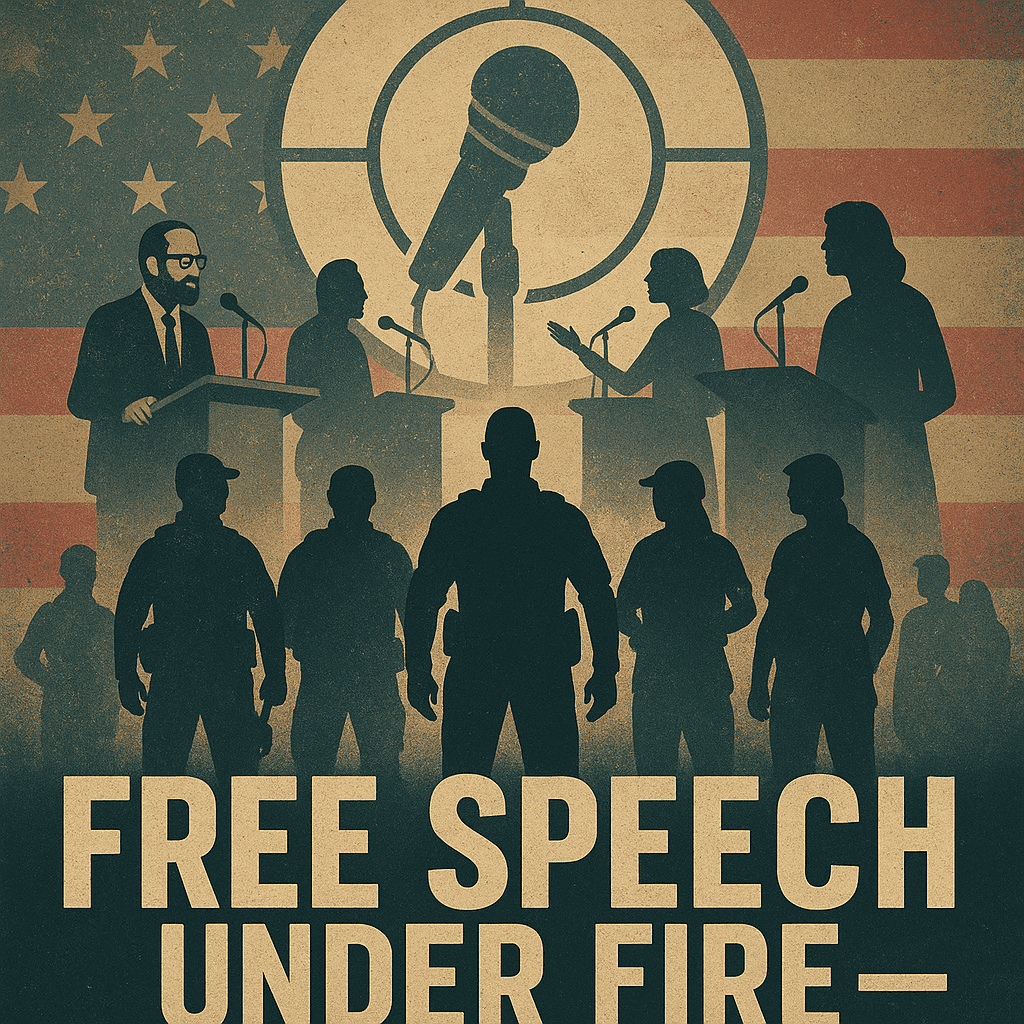
A renewed call to defenders of speech
Here is my bold ask: build a network of event security volunteers rooted in the principles of liberty, not tribal loyalty. We don’t need fists masquerading as ideology. We need people who will show up, guard the speech, and step back quietly when the crowd shouts. Over the years when the Proud Boys have intervened to protect speakers like Shapiro or Sommers, I cheered them. But I cheered the discipline, not the flash.
We need defenders who:
- Are diverse in race, creed, and background
- Focus on event safety, not symbolism
- Train in professional security protocols
- Understand legal boundaries
- Use their presence as deterrent, not provocation
If that network grows, the next time a crowd tries to shut you down with mob force, the microphone, not the mace, still has a chance.
Closing
Tim Pool and Steven Crowder’s podcast raises real alarms. Some of their fears are absolutely justified. But the broader fight requires more than just fear. It requires strategy, discipline, constant principles, better data, and muscle that does not crave violence for its own sake.
I stand with creators who speak under threat. I stand with diverse voices who ask only for a microphone. I stand with lawful defenders who are strong, principled, non-nonsense. And yes, I still believe the Proud Boys, when sober, organized, and legally restrained, have played a role in pushing back against mob suppression of speech. But their future role must be voluntary, accountable, and principled—not performative.
The left claims they fight fascism. Fine. Let’s see if they have the backbone to fight true fascism: the one that uses violence to suppress speech. Let us not surrender speech because we are polite. Let us defend it with courage, restraint, and the kind of muscle that serves liberty, not ego.
— Ryan “Dickie” Thompson, Disruptarian Radio
📚 Sources
Disruptarian References
- Mass Shootings for the Past 20 Years USA (circa 2019)
/blog/mass-shootings-past-20-years-usa/ - Mass Shootings by Demographic 2025 Update: Facts, Spin, and What They Will Not Tell You
/blog/mass-shootings-by-demographic-2025-update-facts-spin-and-what-they-will-not-tell-you/ - Hawaiian Shirts, Order from Chaos, and the Counter-Narrative of the Boogaloo and Proud Boys
/blog/hawaiian-shirts-order-from-chaos-and-the-counter-narrative-of-the-boogaloo-and-proud-boys/ - Interview with Nick Ochs on the Boogaloo
/blog/interview-with-nick-oaks-on-the-boogaloo/
External Sources
- Tim Pool & Steven Crowder Podcast on Political Violence (YouTube)
https://www.youtube.com/watch?v=N7M5KFpG17g - FBI Uniform Crime Reporting Program (overview of violent crime data)
https://ucr.fbi.gov/ - Anti-Defamation League (ADL) — H.E.A.T. Map of Extremist & Hate Crimes
https://adl.org/heat-map - Human Rights Campaign (HRC) Report on Fatal Violence Against Transgender People, 2024
https://www.hrc.org/resources/fatal-violence-against-the-transgender-and-gender-non-conforming-community-in-2024 - Williams Institute (2016) — How Many Adults Identify as Transgender in the U.S.?
https://williamsinstitute.law.ucla.edu/publications/trans-adults-united-states/ - National Institutes of Health: Factors in Transgender Homicides
https://pmc.ncbi.nlm.nih.gov/articles/PMC7427218/ - The Post Millennial: Local Democratic Party Deletes Post Mocking Assassination
(link no longer available, try archive.org) - Coverage of Portland Murder of Aaron Danielson by Antifa Member Michael Reinoehl
(link no longer available, try archive.org)

Spun Web Technology SMART SEO