Rogue's Harbor is live, and for me this is not just a game release. It is a return to a kind of digital folklore that shaped my life before the web became what it is now.
Play Rogue's Harbor on Disruptarian
When I was 13 to 15 years old, Paul Witte's BBS Dark Fortress was a huge part of my childhood. That machine, that phone-line world, that feeling of logging into something secret and alive, mattered. It was not corporate entertainment. It was local, handmade, weird, clever, and full of people who cared enough to build places for other people to explore.
Hanging out at Paul's LAN parties in Orem with other gamers felt like a rite of passage. I was young, and those rooms were full of computers, cables, jokes, competition, discovery, and the sense that games were not just products. They were social spaces. They were shared worlds. They were places where a kid from Utah could find his people.
That is why Rogue's Harbor matters to me. It is not trying to erase the old era. It is trying to carry some of it forward.
The direct historical inspiration begins with Thieves' Guild, the BBS door game created by Paul Witte and Herb Flower under Mythyn Software. The Break Into Chat interview with Paul and Herb is essential reading because it documents the Orem/Utah roots, the Atari ST connection, the art, the maps, the quests, the cities, and the imagination behind the original game. Read the interview here.
That article helped clarify what I already felt from memory: these games came from people, places, friendships, hardware limits, late nights, and ambition. They were not abstract software. They were artifacts of a scene.
I also have to credit Ultima Online. I played it with my brother Brad, and the years of bonding with him through that world became Happy Moments that stayed with me. The shared danger, the houses, the trading, the strange economy, the feeling that another player could change your night completely, those things became part of how I understood online games.
Rogue's Harbor blends many of the things I loved as a kid and young adult: BBS door games, fantasy towns, thieves, taverns, maps, player economies, old-school danger, multiplayer social presence, and a living world that can keep expanding.
This release is still a beginning. The game now runs in the browser with accounts, a user dashboard, a larger map, expanded towns, NPCs, quests, shops, taverns, banks, items, inventory, multiplayer foundations, leaderboards, server-side economy controls, and the beginning of player land, houses, stores, buying, selling, and trading.
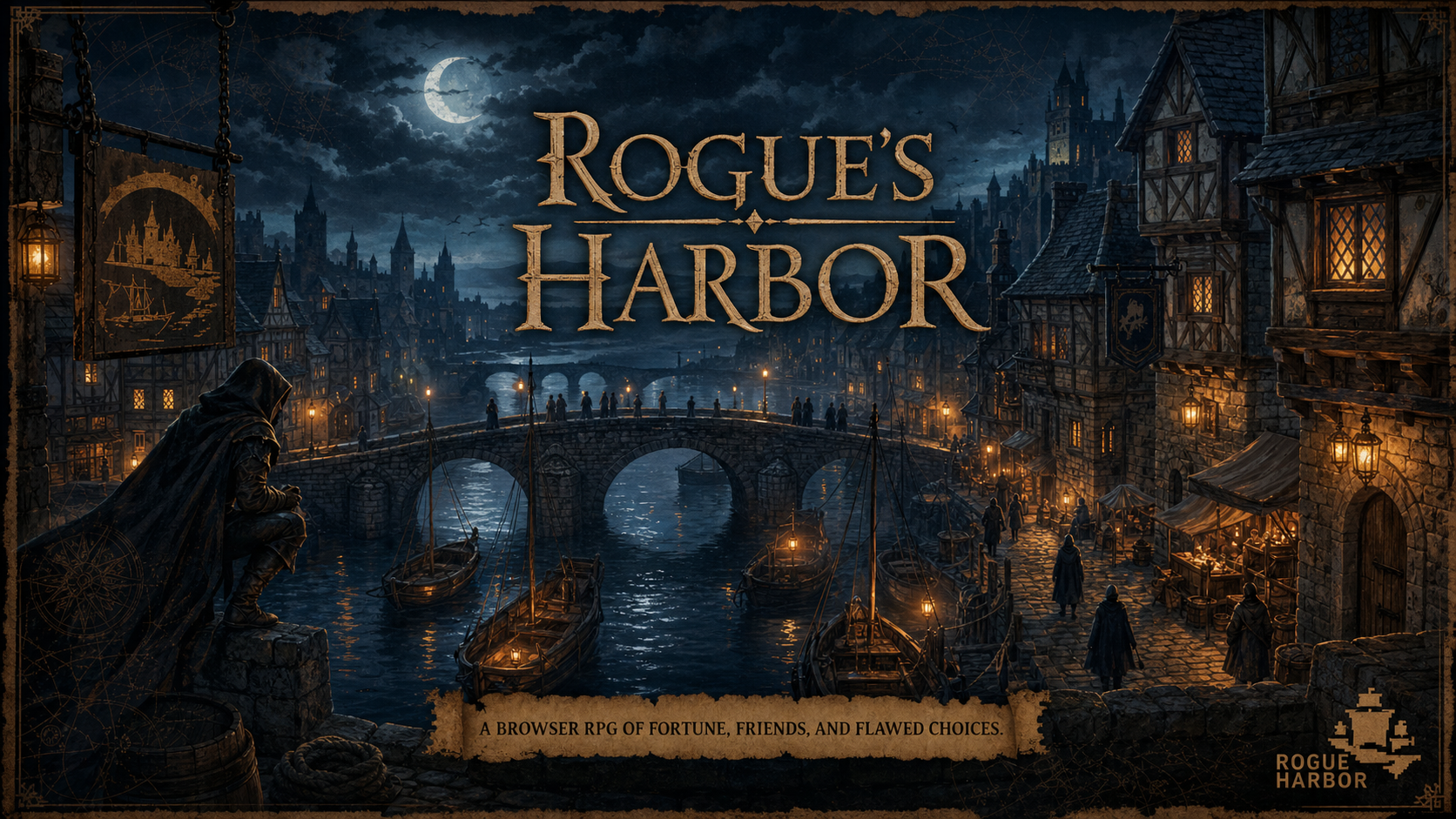
The art direction is intentionally modern but nostalgic. I wanted the mood to remember the 1990s without being trapped by 1990s limitations: moonlit harbors, stone bridges, torchlight, boats, tavern windows, cloaked figures, and that old fantasy feeling that something useful, dangerous, or ridiculous might happen if you take one more step down the road.
Credit where credit is due: Paul Witte and Herb Flower built something that left a mark. Dark Fortress left a mark. Those LAN parties in Orem left a mark. Ultima Online with Brad left a mark. Rogue's Harbor exists because those memories did not go away.
So this is a launch announcement, but it is also a thank-you note to the people, games, and moments that made this kind of world feel possible.