

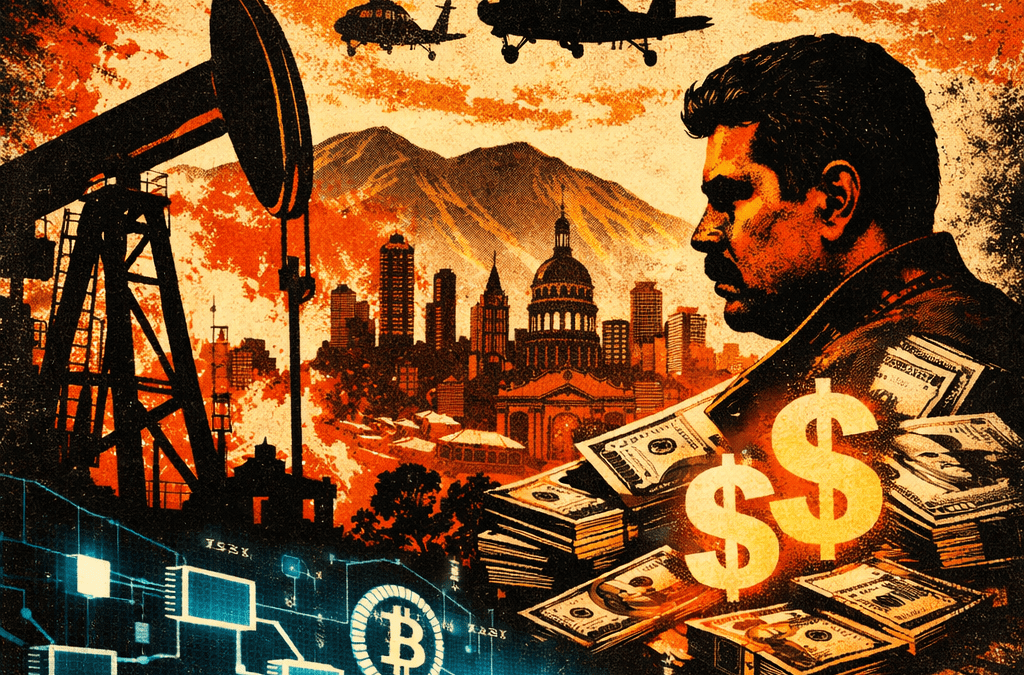
If you only listened to the official story, you’d think the U.S. raid on Venezuela in early January 2026 was basically a giant anti-drug bust with a flag on it. The public justification leaned hard on narco-terrorism, the Cartel of the Suns, and the long-running allegations that Nicolás Maduro’s inner circle has been neck-deep in trafficking and brutality.
I’m not here to defend Maduro. The guy’s government has earned a lot of the hatred it gets.
But here’s the thing. When Washington moves with this kind of speed and scale, you should assume there’s more going on than the talking points. The press releases are the wrapping paper. The motive usually lives in the boring stuff: money flows, settlement rails, energy leverage, and the U.S. dollar’s role as the world’s default trading chip.
If you want to understand why this happened now, you have to look under the hood.
Not because everything is some cartoon villain plot. Because incentives are real. Power protects itself. That’s not “conspiracy,” that’s history.
1) What just happened, in plain English
On January 3, 2026, U.S. forces captured Venezuelan President Nicolás Maduro. Reports described a major operation, not a “small team, in and out” situation. Think big assets, big coordination, big political risk.
And then came the part that really matters: almost immediately, U.S. officials and related reporting started talking openly about Venezuela’s oil and how it would be managed, sold, and where the money would go.
That’s not normal. That’s not “just a drug case.”
So either the U.S. government suddenly decided this was the moment for the most intense counter-narcotics move in decades, or there were deeper strategic reasons lined up behind the scenes.
I’m betting on the second one. If you’ve watched this movie before, you know the plot.
2) Why oil still matters more than people admit
Everybody loves to talk like oil is over. Electric cars, solar panels, wind farms, the “transition.” I’m not anti-innovation. I want cheaper, better energy. Always.
But I also live in reality.
Oil still fuels global logistics. It powers shipping, aircraft, heavy equipment, supply chains, and a lot of manufacturing inputs. Petrochemicals are everywhere. Fertilizer systems depend on fossil inputs too. You can’t replace all that at scale overnight. Not even close.
Now add geopolitics: oil isn’t just energy, it’s leverage.
Venezuela matters because it sits on a massive reserve base. The country’s proven reserves are widely cited as among the largest in the world. Even if current production is impaired, reserves are the long game. Infrastructure can be rebuilt. Fields don’t just vanish.
So when you see a U.S. operation followed by talk of oil sector control and rebuilding, you’re looking at a strategic asset in play.
3) The petrodollar: how oil trade props up dollar power
Here’s the part most mainstream coverage avoids, because it makes people uncomfortable.
For decades, a large chunk of global oil trade has been priced and settled in U.S. dollars. That arrangement helped turn the dollar into the world’s default settlement currency for trade, and it reinforced America’s financial reach.
Why does that matter?
Because if the world needs dollars to buy oil, the world needs access to dollar liquidity. That keeps demand for dollars high, strengthens the U.S. financial system, and gives Washington a kind of structural advantage. It also makes deficit financing easier than it should be, because a lot of foreign buyers keep dollars and dollar assets in circulation.
That’s what people mean by “petrodollar.” Not magic, not secret codes. A system.
And systems create chokepoints.
The U.S. has huge leverage because the “pipes” of global finance run through dollar clearing, big banks, compliance regimes, and settlement networks tied to U.S. jurisdiction. If you can control access to the pipes, you can punish rivals without firing a shot. Or at least, that’s the idea.
This is why sanctions are so powerful. And it’s why countries that get sanctioned don’t just sit there and cry, they start building ways around it.
4) Venezuela’s quiet shift into crypto settlement
Sanctions don’t just restrict. They teach.

Maduro oil and crypto
When an exporter can’t reliably get paid through traditional banking channels, it starts experimenting. Some of those experiments are shady. Some are clever. Some are just desperate. But experimentation happens because the incentives force it.
In Venezuela’s case, reporting in recent years described PDVSA and intermediaries leaning into digital payment methods, including stablecoins like USDT (Tether), especially as sanctions enforcement tightened.
The claim that got the most attention was that a very large share of Venezuelan oil payments shifted into USDT, with numbers floating around as high as 80% for certain periods. I’m not going to pretend anybody has a perfect spreadsheet of sanctions-busting settlement flows. But the broader point is hard to deny: Venezuela has been moving oil money in ways designed to reduce exposure to traditional banking choke points.
That’s the story behind the story.
Because once oil starts settling outside the standard rails, it’s not just “Venezuela doing Venezuela things.” It becomes a test case for a bigger idea: can energy exporters sell into global markets without being trapped in dollar-controlled settlement infrastructure?
If the answer is “yes,” even partially, Washington loses a lever.
And Washington hates losing levers.
5) Why USDT-style payments make Washington itchy
Stablecoins are not perfect. They can be frozen. They can be traced. They can be regulated into the ground if governments coordinate hard enough. Also, crypto land is full of scammers and carnival barkers. True.
But stablecoins solved one real-world problem: moving value across borders can be faster, and sometimes harder to block mid-transaction, than traditional bank wires.
In a sanctions environment, that’s a feature.
Here’s why it’s threatening, from a U.S. power perspective:
- Banks are compliance choke points. Stablecoin settlement can reduce reliance on banks that fear OFAC.
- SWIFT and correspondent networks are choke points. You can route around the messaging layer in certain scenarios.
- Ownership can be opaque in practice. Blockchains are public, but mapping wallets to real-world actors is messy unless you have keys, subpoenas, and cooperation.
So even if a stablecoin is “dollar-denominated,” it’s not necessarily dollar-denominated under U.S. control. That’s the rub.
It’s like someone using your currency but refusing to use your cash register. You still see the symbol, but you don’t control the transaction.
Now imagine that happening in oil markets, the most strategically sensitive market on earth. That’s when this stops being a niche finance story and turns into a geopolitical fight.
6) China’s digital yuan push and why timing matters
Now layer China onto this.
China has been building its own payment infrastructure and digital currency capabilities for years. The long-term goal is obvious: reduce dependence on U.S.-linked settlement and build financial rails that can operate at scale outside Washington’s reach.
In late 2025 and early 2026, reporting described a step-up in China’s digital yuan management and functionality, including changes around how the digital yuan ecosystem would be handled going forward.
One specific detail that got attention was the idea of digital yuan functionality becoming more “deposit-like,” including interest-bearing features. Whether you call it interest, yield, or account-style functionality, the point is the same: it makes the system stickier. People are more willing to hold something if it behaves like money you can park, not just money you can spend.
Now, do I have a signed confession saying the U.S. raid on Venezuela was triggered by China’s digital currency roadmap?
No. Of course not.
But timing matters in geopolitics, and in markets. If you see:
- Venezuela experimenting with non-traditional settlement for oil,
- China building more capable digital currency infrastructure,
- and a sudden U.S. move that removes Maduro and immediately centers oil control,
you don’t have to be a genius to connect the dots.
At minimum, Washington likely saw Venezuela as a live-fire test of de-dollarized commodity settlement, and it decided to end the experiment before it spread.
That’s the kind of thing states do. It’s not pretty, but it’s predictable.
7) “Counter-narcotics” vs “control the oil,” spot the difference
Let’s talk about the public narrative.
The public case leaned on drugs, terrorism, security. And sure, those issues are real. Venezuela has been accused of corruption and trafficking for a long time. So it’s not like the U.S. had to invent a moral argument out of thin air. It already had one.
But watch what governments do, not what they say.
After the operation, reporting described U.S. officials and the administration talking about controlling Venezuelan oil flows and oil revenues, including the idea that revenues could be directed into U.S.-controlled accounts, supposedly to drive political change.
That’s not a minor detail. That is the ballgame.
If the mission is really about narcotics enforcement, the oil revenue architecture is, at best, a side effect. But in this case it’s front and center, right away.
So what are we looking at?
We’re looking at a power play to regain control of an energy asset and the money that comes from it, and to prevent that asset from being used to test alternative settlement systems outside U.S. leverage.
That fits the pattern.
8) Regime change as an economic tool
This is where I get a little more blunt, because people keep pretending this isn’t happening.
Regime change didn’t disappear when the Cold War ended. It just got rebranded. Sometimes it’s “humanitarian intervention.” Sometimes it’s “anti-terror.” Sometimes it’s “protecting democracy.” Sometimes it’s “counter-narcotics.”
And sometimes, it’s economic.
If a country sits on strategic resources and starts conducting trade in ways that reduce U.S. leverage, Washington tends to notice. Then it starts using whatever legal or moral frame is available to justify action.
That doesn’t mean the moral frame is always fake. It means it’s rarely the whole story.
Here’s the hardest truth for liberty-minded people: the U.S. government often treats economic dominance as a national security priority. When you accept that premise, almost anything becomes “security.” Currency systems become security. Payment rails become security. Energy settlement becomes security.
Once everything is security, war becomes policy.
And that’s a problem.
9) The blowback risk: force can speed up de-dollarization
Here’s the irony that should haunt every strategist who thinks force can hold a financial system together.
If the dollar is dominant because it’s stable, trusted, and useful, it shouldn’t need an aircraft carrier vibe to keep customers.
When a global power uses hard force to defend currency leverage, it signals vulnerability. It tells other countries, “Yes, there is a weak point, and yes, we are willing to fight to protect it.”
That’s not reassuring. That’s motivating.
So the short-term effect of a Venezuela operation might be to snap oil flows back under a more U.S.-friendly structure. Fine. But the long-term effect could be that countries accelerate efforts to build alternatives, because they don’t want to live under a system where Washington can flip the off switch.
This is where stablecoins, direct settlement systems, and CBDCs come back into the story.
You can’t bomb an idea out of existence once it solves a real problem. You can scare people for a while, sure. But the incentives remain. And incentives always win eventually.
10) What liberty-minded people should take from this
I don’t care if you’re left, right, libertarian, or just exhausted by politics. There are a few principles that still matter.
Sovereignty matters, even when the government is awful
A government being corrupt doesn’t automatically make invasion or capture morally clean. If we decide “bad government” equals “open season,” then nobody is safe, because every government has skeletons.
Economic competition is not war
If Venezuela wants to sell oil in dollars, fine. If it wants to sell oil in yuan, USDT, barter, shells, whatever, that’s a trade choice. Markets should decide winners based on outcomes, not missiles.
Sanctions and coercion create innovation, just not the kind you like
When you squeeze a system hard enough, people route around it. That’s not even ideological, it’s survival logic. So if Washington wants fewer alternative settlement systems, it should consider whether constant financial warfare is producing the exact opposite result.
Regime change rarely delivers freedom
You can topple a leader and still end up with chaos, corruption, or a different flavor of authoritarianism. “Friendly to U.S. interests” is not the same thing as “free.”
Liberty includes getting off the empire treadmill
A free society should be allergic to the idea that military force is the enforcer of global economic rules. That’s not freedom. That’s domination. It also bankrupts you over time. Slowly, then all at once.
11) What to watch next
This story isn’t done. Not even close. If you’re trying to read where this goes, watch these things:
- Who controls PDVSA contracting and export permissions now. That tells you who controls the cash.
- How quickly production can be restored. Venezuela’s infrastructure has been battered. “We’ll rebuild it” is easy to say, harder to do.
- China’s next move. China doesn’t like losing access to strategic oil supply and regional influence. Expect counter-moves, financial and diplomatic at least.
- The crackdown on alternative settlement rails. If stablecoin settlement was a real factor, expect more pressure on intermediaries, wallets, and networks.
- Whether other exporters copy the model anyway. If Venezuela proved it can move money outside the usual rails, even partially, other sanctioned states will learn from that, even if it ends badly for Venezuela.
That’s the real battlefield now. Not just territory. Settlement.
The bottom line
The U.S. intervention in Venezuela wasn’t just about narco-terrorism, even if that was the clean headline.
It was about oil, currency competition, and control of the financial plumbing that props up U.S. leverage. The public story gives people a moral reason to accept it. The oil-and-money story explains why it happened now, why it was so big, and why the aftermath immediately focused on controlling oil flows and revenues.
If you believe in free markets and voluntary trade, this should make you uneasy.
Because once governments start treating financial competition like a military threat, we’re not doing markets anymore. We’re doing empire.
And empires don’t age well.
Sources (hyperlinked)
- TIME: What’s Happening With the U.S. and Venezuela, Explained
- Reuters: US needs to control Venezuelan oil sales, revenue to drive change, says energy secretary
- AP News: Why the US has designs on Venezuela’s oil
- Atlantic Council: How Venezuela uses crypto to sell oil, and what the US should do about it
- Reuters: Exclusive: Venezuela to accelerate cryptocurrency shift as oil sanctions return
- CGTN: Digital Currency: China to enhance digital yuan with interest-bearing features from 2026
- Reuters: China to issue digital yuan management action plan
- AP News: US plans to “run” Venezuela and tap its oil reserves, Trump says, after operation to oust Maduro
- ABC News: Inside the meticulously planned operation to capture Maduro

Spun Web Technology SMART SEO