The Charlottesville Narrative Problem: What If the Gatekeepers Aren’t Clean?
By Ryan “Dickie” Thompson
Something feels off. Not just about this latest claim involving the Southern Poverty Law Center, but about the entire ecosystem that grew around events like Charlottesville.
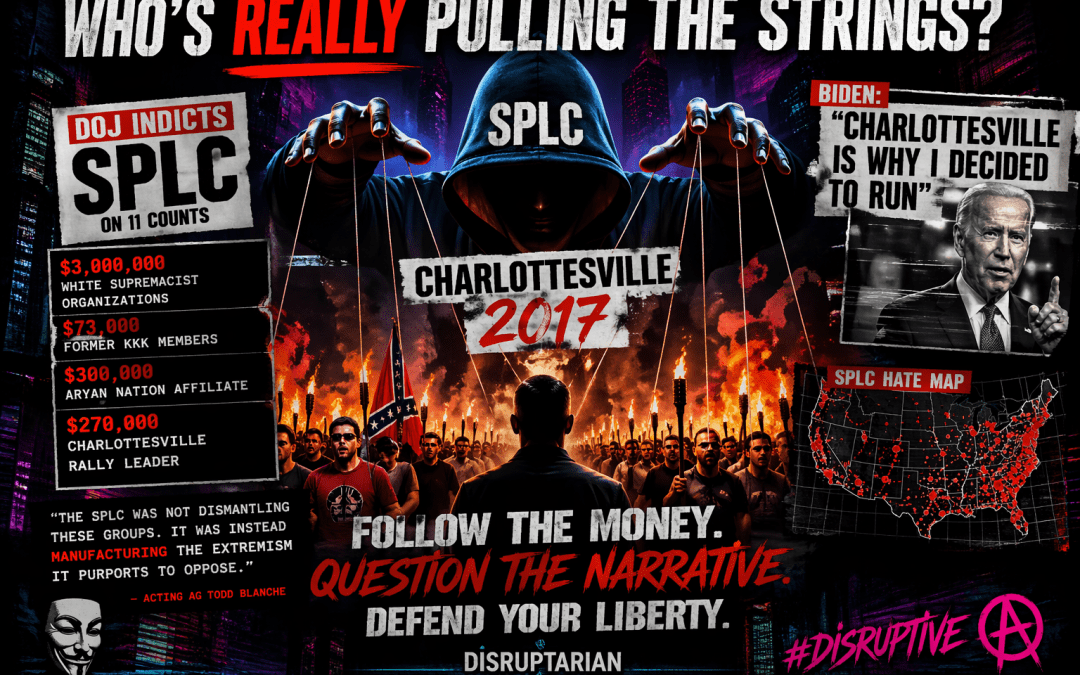
Now we have a fresh allegation circulating. The Southern Poverty Law Center is accused of financially supporting individuals tied to extremist groups, including figures connected to the Unite the Right rally. The claim is explosive. It cuts right into the narrative that shaped modern politics.
Before we go any further, we need to be clear. These claims are still disputed. They are being debated, pushed, and challenged. But the bigger story here is not just whether this specific case is true. It is what it reveals about power, incentives, and narrative control.
The Incentive Nobody Talks About
Groups like the SPLC operate in a strange market. Their product is moral urgency. Their currency is fear of extremism.
That creates a tension.
If extremism declines, funding dries up. If threats grow, donations surge.
After Charlottesville, the SPLC saw a major fundraising boom. That is not speculation. That is public record. Big donors stepped in. Media coverage intensified. Their influence expanded.
So here is the uncomfortable question.
What happens when your survival depends on the existence of the very problem you claim to fight?
That does not prove wrongdoing. But it creates a system where exaggeration, selective framing, or even reckless tactics become more likely.
Informants or Something More?
One defense raised in response to these allegations is familiar. The SPLC says it used informants. That is standard practice. Law enforcement agencies do this all the time.
Fair enough.
But there is a key difference.
Government agencies use informants to stop crimes and prosecute offenders. A private nonprofit uses informants while also fundraising off the threat those same groups represent.
That is a conflict of interest.
If money flows from fear, then fear becomes a resource. And when fear becomes a resource, it can be manipulated.
The Charlottesville Effect
The Unite the Right rally did not just stay in Virginia. It became a political launchpad.
Joe Biden pointed to Charlottesville as a key reason for entering the 2020 race. Media outlets used it as proof of a rising national threat. Corporations, universities, and government agencies followed with policies built on that narrative.
But here is what often gets lost.
Most Americans never saw anything like Charlottesville in their own communities. Yet they were told constantly that this threat was everywhere.
That gap between lived reality and media narrative matters.
The Pattern of Narrative Inflation
If you look back over the past decade, you start to see a pattern.
Stories about hate and extremism get amplified fast. They spread across media, politics, and culture. Then later, details come out that complicate the story.
Sometimes it is exaggeration. Sometimes it is outright fabrication.
The Disruptarian piece on fake hate crimes lays this out clearly. Cases like Jussie Smollett or others show how quickly false narratives can gain traction when they fit a preferred storyline.
Read it here: Fake Hate Crimes and the Incentive to Lie|https://disruptarian.com/blog/fake-hate-crimes-renee-good-floyd/
This does not mean all hate crimes are fake. That would be dishonest. But it does mean the system rewards stories that push a certain narrative, whether they are true or not.
Media, Money, and Power
The media plays a huge role in this loop.
When a story fits the narrative, it gets wall to wall coverage. When it falls apart, the correction is quiet. Sometimes it is ignored.
That creates a one way ratchet. Fear goes up. Trust goes down.
The Hill covered the current SPLC controversy and noted how critics see this as a major credibility issue:
SPLC controversy coverage|https://thehill.com/video/wow-splc-caught-paying-hate-groups-conspiracy-theorists-win-robby-soave-rising/11727279/
And discussions like this are gaining traction online as more people question the official story:
YouTube discussion on SPLC allegations|https://www.youtube.com/watch?v=YdFzl8taL-k
What This Means for Liberty
This is where the libertarian lens matters.
Centralized institutions, whether government or nonprofit, should never be trusted blindly. Power concentrates. Incentives distort behavior. Narratives get shaped to protect influence.
If the SPLC is clean, then it should welcome scrutiny. If it is not, then accountability is overdue.
Either way, the answer is the same.
More transparency. Less blind trust.
Final Thought
The real danger is not just extremism. It is the manipulation of truth for power.
If people are being misled about the scale or nature of threats, that leads to bad policy, more control, and less freedom.
And once that machine gets going, it does not slow down on its own.
You have to question it.
Always.
WordPress Excerpt
New allegations against the SPLC raise deeper questions about incentives, media narratives, and the truth behind Charlottesville. Are we being told the full story, or just the useful one?
Keywords
SPLC, Charlottesville, Unite the Right, media bias, fake hate crimes, libertarian perspective, political narratives, nonprofit incentives, extremism, Joe Biden Charlottesville, media manipulation, civil rights organizations, fundraising incentives, government trust, institutional power, Robby Soave SPLC, hate crime hoaxes, narrative control, free market ideas, Disruptarian
Featured Image


Sources
- YouTube discussion on SPLC allegations|https://www.youtube.com/watch?v=YdFzl8taL-k
- The Hill coverage of SPLC controversy|https://thehill.com/video/wow-splc-caught-paying-hate-groups-conspiracy-theorists-win-robby-soave-rising/11727279/
- Disruptarian article on fake hate crimes|https://disruptarian.com/blog/fake-hate-crimes-renee-good-floyd/

Spun Web Technology SMART SEO