
When Accusation Becomes a Test of Character

A family argument about Donald Trump became a question about evidence, judgment, and what we owe one another when the stakes are serious.
Personal commentary. The child in this account is not named. The message transcript and screenshots are included as supporting context.
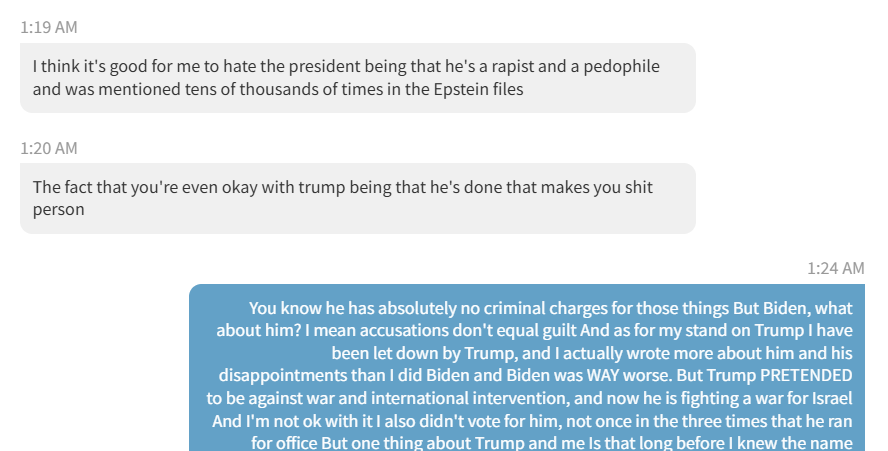
A child asked me a question that was also an accusation: how could I support a man described as a rapist and a pedophile? I answered with the standard I have applied for years: accusations are not the same thing as proof, and public pressure should not replace evidence.
That answer was incomplete. I focused on the absence of a criminal conviction for the conduct being discussed, and I did not acknowledge a major civil finding that belongs in the same conversation. A New York jury found Donald Trump liable for sexually abusing E. Jean Carroll and defaming her. That was a civil verdict, not a criminal conviction; on the specific rape question, the jury did not find that he had committed rape under the definition then provided. The Second Circuit’s opinion describes the verdict. Trump has sought U.S. Supreme Court review, and the Court’s docket currently shows that Carroll’s response is due October 30, 2026. Those distinctions matter. They do not erase the civil jury's finding, and the civil finding does not become a criminal conviction by changing the label.
My child used “pedophile” as another label. That is a serious accusation, and I still believe serious accusations require evidence. But the parental alienation issue is not based only on this political argument. When my ex-wife and I divorced, the first time I was with the children afterward, all of them told me on a DVR recording that their mother wanted them to choose sides. They later told the same basic story to their therapist. In my experience, that makes the parental alienation an established fact, not a theory inferred from one difficult conversation.
What the exchange exposed
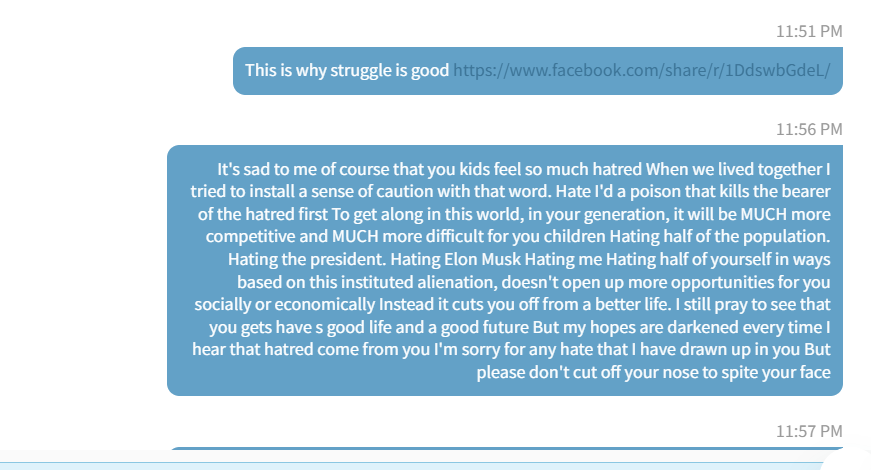
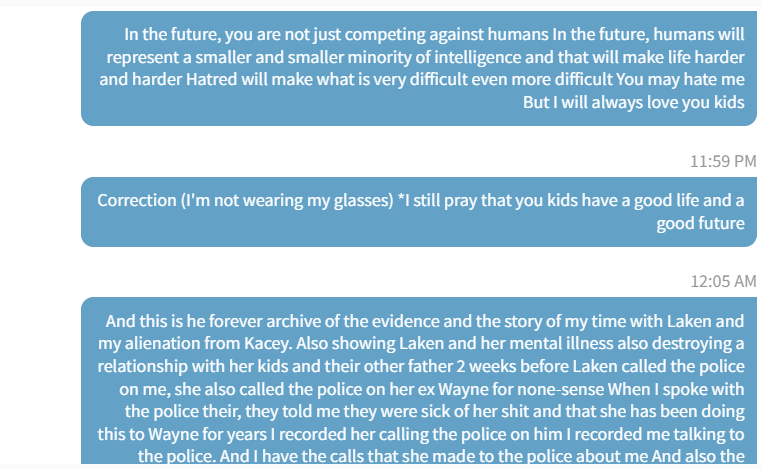
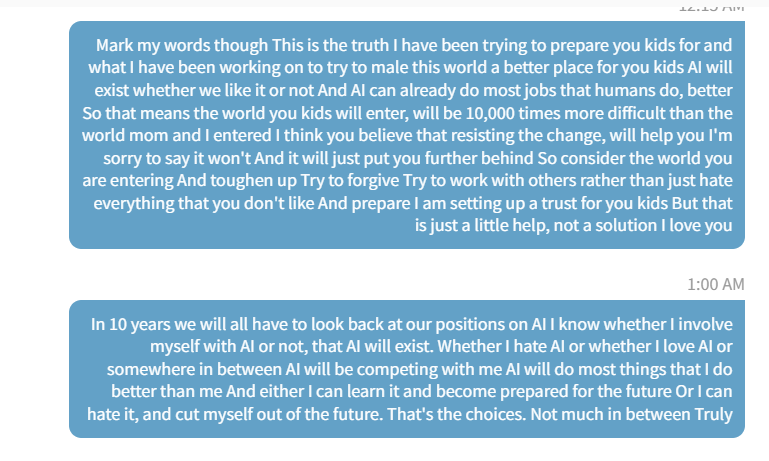
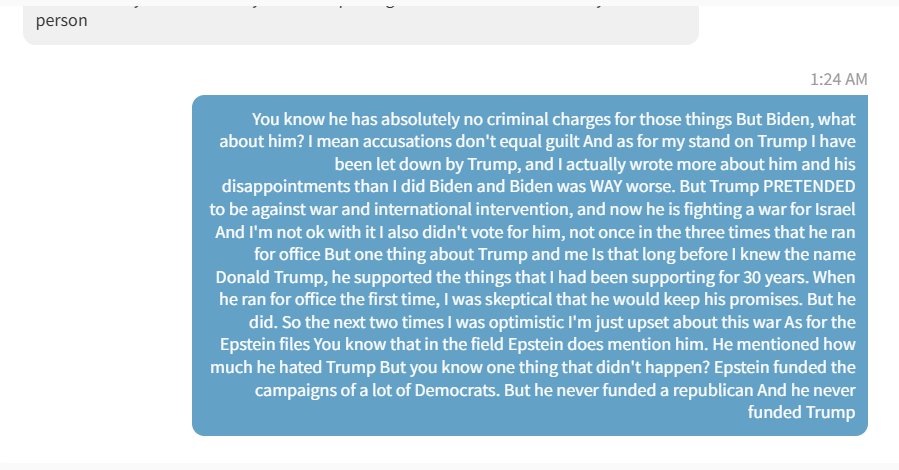
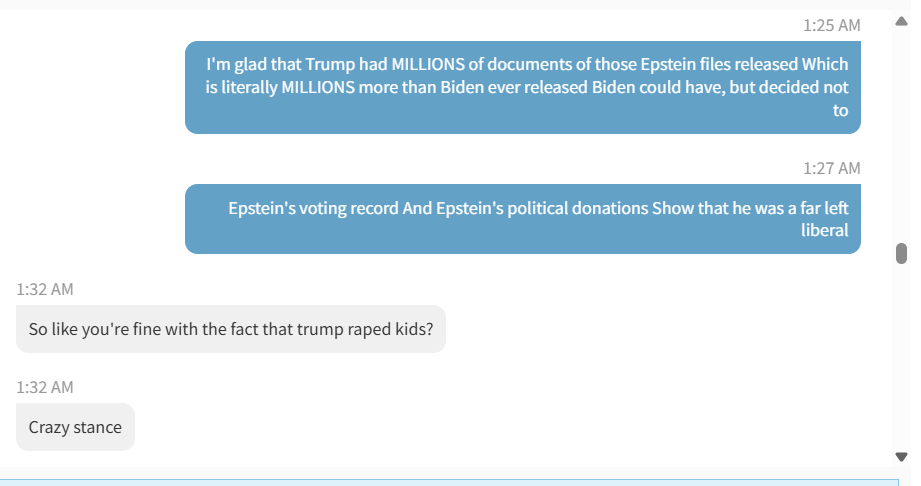
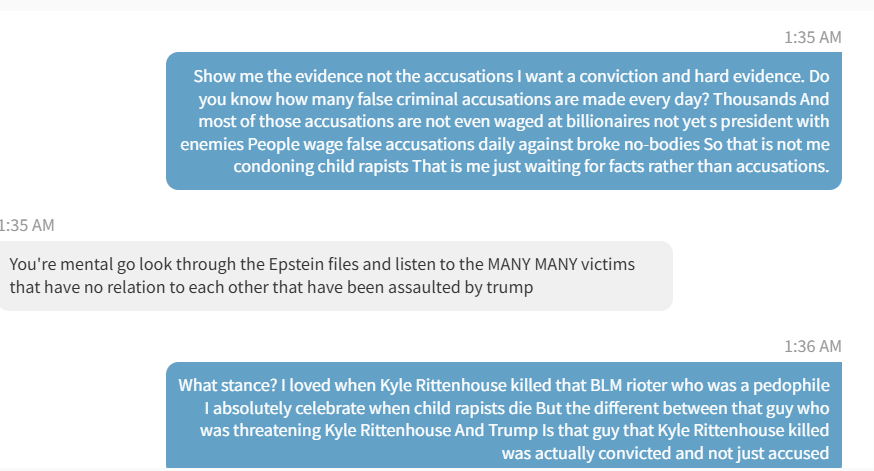
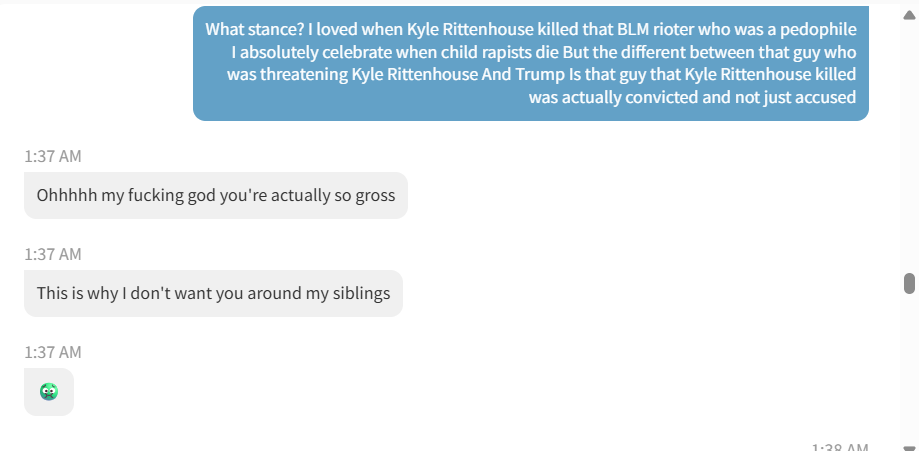
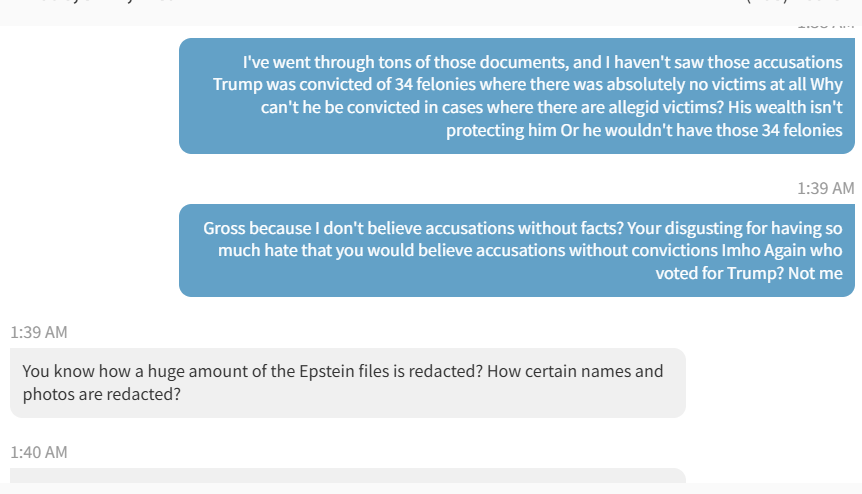
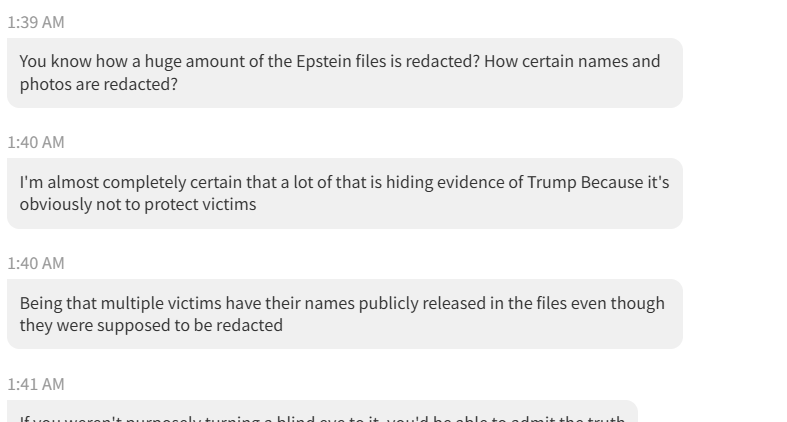
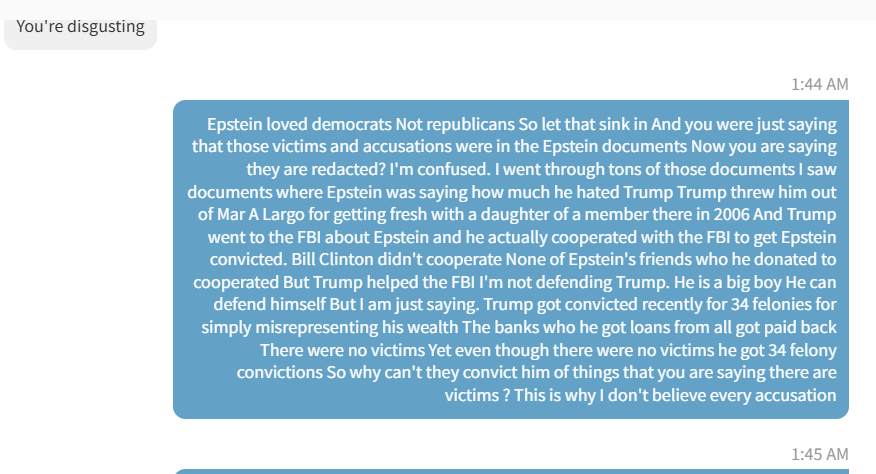
The screenshots and transcript show a family conversation that quickly stopped being a careful discussion of evidence. We called each other names. I brought politics, AI, family conflict, and old grievances into one long exchange. My child said they did not want me around their siblings. I responded with arguments about hatred and how I believe young people should prepare for a difficult future.
I can stand by the principle that allegations deserve careful examination and still admit that I handled parts of that conversation badly. A parent cannot expect a child to listen after turning a disagreement into a judgment about the child's character. And a child should not have to agree with a parent's politics to be loved or treated with respect.
This exchange belongs inside that larger history. It shows how political labels became personal weapons inside a family, how quickly people stopped hearing one another, and how the alienation was reinforced through accusations about my character and my relationship with the children.
There is no honest shortcut from accusation to certainty
The notes I attached try to estimate a national total by applying percentages from limited studies to broad crime totals. That calculation does not give us an observed nationwide count. The FBI’s 2025 release reports more than 13 million offenses submitted by participating agencies; that figure does not tell us how many allegations were later determined to be false. A percentage found in studies of one category cannot simply be applied to all reported crime.
A 2016 meta-analysis of seven studies estimated that 5.2% of sexual-assault reports in those studies were confirmed false, with a 95% confidence interval of 3.0% to 8.9%. That is a specific research result about those studies and that category. It is not a universal false-accusation rate, and it does not tell us that an acquittal, a dismissed case, or an unproven claim was a lie.
The National Registry of Exonerations’ 2025 report says that 71 exonerations (73%) included perjury or false accusations. Exonerations are a selected group of cases in which a conviction was later overturned; that finding is not a measure of how often accusations are false across the country. It does, however, show why wrongful convictions and dishonest testimony deserve serious attention.
There are two easy errors here. One is to treat every accusation as established fact. The other is to treat every accusation without a conviction as fabricated. Both errors can hurt real people. The right response is to ask what the evidence shows, what it does not show, and what standard of proof is being used.
I want better tools than slogans
For years I have said we should stop getting distracted by the latest accusation against a public figure or decision-maker and build better ways to evaluate contested claims. I want methods that can approach very high reliability, with transparent evidence and safeguards against false positives and false negatives. That is part of why I created Veracity Integrity.
I need to be precise about the ambition. Existing polygraph tests are not nearly 100% reliable truth machines. They measure physiological responses, which can have causes other than deception, and the American Psychological Association and National Academies describe substantial limitations in the evidence. A system that claims near-perfect accuracy should have to prove it through independent, blinded testing, publish its error rates, explain how it handles uncertainty, and allow people to challenge its conclusions. I want that level of reliability. I cannot honestly say it has already been achieved.
That standard should apply especially when the person making the accusation is powerful—or when the accused person has money, influence, and real enemies. Power can help someone suppress evidence. It can also make a person a target. Neither possibility tells us what happened in a particular case. Evidence does. For an ordinary person, too, a damaging accusation can travel faster than any investigation and be difficult to answer without money, influence, or access to a fair hearing.
I have made many videos over the years about accusations, evidence, and how public claims are treated. They are collected through Disruptarian Radio’s YouTube search for “accusations”. I do not expect anyone to take my word for it. Look at the material, look at the limits, and decide what the evidence supports.
A standard I have to apply to myself
In that late-night exchange, I demanded evidence from my child while making claims of my own—about crime statistics, political history, and what public records supposedly proved. Some of the numbers in my attached notes were extrapolations, not measured national totals, and I have corrected that distinction here. I also should have acknowledged the Carroll civil verdict before arguing that the absence of a criminal conviction settled anything. It did not. A civil judgment has nothing to do with criminal wrongdoing. At the same time, reports in late May 2026 said that the U.S. Department of Justice had opened a criminal investigation into whether E. Jean Carroll committed perjury during her civil lawsuits against Donald Trump. The U.S. Attorney for the Northern District of Illinois later disputed that his office had opened such an investigation, so the public record contains a reported probe and a denial. The matter remains unresolved; there has been no criminal conviction.
As I have said repeatedly on my YouTube channels and in my writing, I did not vote for Trump. I considered him much better aligned with my established views on freedom and the economy than the other leading candidate. I vehemently disagree with the war in Iran and with other decisions that make it difficult for me to feel enthusiastic about him. His first campaign’s America First, non-interventionist position was one of the biggest reasons I found him appealing; the current war is a serious departure from that expectation. Trump did not create my political views. I have held them for more than thirty years. He fit those views better than the alternatives available. I would have preferred Ron Paul or Rand Paul, but we got Trump. My position has always been a judgment about competing policies, not a declaration that every action by the person I voted around is right.
My child and I may continue to disagree about Trump, politics, and the words we use. I want a relationship in which disagreement does not end the conversation or become a verdict on whether either of us is a decent person. If I want evidence instead of slogans, I have to make room for correction when the evidence complicates my own argument.
Sources and conversation record
- FBI: 2025 reported crimes in the nation
- Ferguson and Malouff: 2016 meta-analysis
- National Registry of Exonerations: 2025 exonerations
- Second Circuit opinion in Carroll v. Trump
- U.S. Supreme Court docket 26-141
- American Psychological Association: polygraph testing
- National Academies: The Polygraph and Lie Detection
- Associated Press: E. Jean Carroll legal battle and reported DOJ investigation (pending)
- Disruptarian Radio videos on accusations
- Veracity Integrity
Conversation record
Open the author-provided conversation transcript (.txt) in a separate tab
The following screenshots preserve the exchange as it happened. The attached transcript has family first names redacted.
Related Reading
Similar posts

2026-09-21 · Culture
The Long Fight to Restore a Father-Daughter Bond
A first-person account of a relationship, a daughter caught in its aftermath, the records preserved in a long video, and a father’s effort to leave a path open for repair.
2026-09-21 · Commentary
Patriarchy Theory Is Marxism With the Classes Changed
Patriarchy theory did not simply point out unfairness. In its radical form, it borrowed the Marxist oppressor-oppressed model and changed the central class struggle from capital to sex.
Related · Digital Rights